560th Plenary session, in the presence of AdinaVălean, European Commissioner for Transport, and Nicolas Schmit, European Commissioner for Jobs and Social Rights.
The pandemic transformation is causing a significant shift in the global balance of power. The EU must act as soon as possible to boost Europe's economic resilience in the COVID-19 context and build its open strategic autonomy. This includes, among other elements, strengthening the international role of the euro, increasing the resilience of European financial market infrastructures, and improving the enforcement of EU sanctions.
Against this background, the European Economic and Social Committee (EESC) welcomes the recent communication of the European Commission on The European economic and financial system: fostering openness, strength and resilience [COM(2021) 32 final] and will hold a public hearing to discuss the specific policy recommendations and key actions it contains. The hearing will feed directly into the upcoming EESC opinion on the Commission's communication and the related inter-institutional debate.
The new Roma framework presents seven areas of focus for the next 10 years: fighting antigypsyism and discrimination; reducing poverty and social exclusion; promoting Roma participation; access to quality education; access to quality and sustainable employment; improving Roma health and equal access to housing. It provides targets to be attained by 2030 and recommendations for their attainment.
The hearing aims to look at the proposals and plans outlined in the new Roma framework in more detail. It will also include a discussion with civil society organisations, giving them the opportunity to voice their views and expectations thereon.
To improve the implementation of the EU Charter of Fundamental Rights it is necessary to empower civil society organisations, rights defenders and justice practitioners, and strengthen people’s awareness of their rights under the Charter. CSOs and social partners are operating at grassroots levels and can help spread awareness and foster implementation. Moreover, the social partners have a special role in contributing to the implementation and defence of socio-economic fundamental rights.
The European Economic and Social Committee (EESC) will hold a major online conference on Energy poverty at the crossroads of the European Pillar of Social Rights and the European Green Deal on 20 April 2021 from 10 a.m. to 4 p.m.
Seminar organized by the European Economic and social Committee (EESC) and the Project Consortium Co-creation of service Innovation in Europe (CoSIE)
Event type
Webinar
Location
Brussels
Belgium
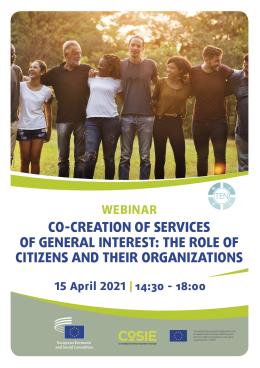
The Thematic Study Group on Services of General Interest of the TEN Section co-organises with the Project Consortium Co-creation of Service Innovation in Europe (CoSIE) a Webinar onCo-creation of Services of General Interest: the Role of Citizens and their Organizations on 15 April at 2.30 p.m.
Interactio and Room JDE 62, EESC building, Rue Belliard 99, 1040 Brussels
Brussels
Belgium
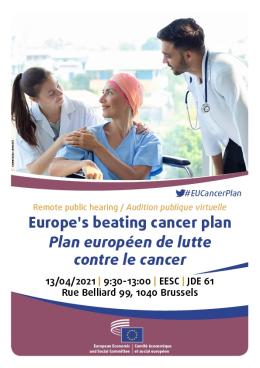
In order to prepare its opinion on the Commission's proposal "Europe's Beating Cancer Plan", the EESC is organising a public hearing on 13 April 2021 am.
The aim of the event is to gather input from other EU Institutions, civil society and health professionals. We will debate the following questions:
What are the strengths and weaknesses of the current proposal?
What kind of activities do different actors carry out with respect to beating cancer, and are there any best practices to be shared?
The 7th meeting of the EU-Moldova Civil Society Platform took place on 30-31 March 2021 in the format of a videoconference. During the meeting, a debate focused on assessing the state of play of the implementation of the EU-Moldova Association Agreement. The impact of the COVID 19 pandemic on the socio-economic development of Moldova was also discussed as well as the aspect of digitalisation in health care in Moldova.
Interactio and Room JDE 62, EESC building, Rue Belliard 99
Brussels
Belgium
The EESC Thematic Study group on Disability Rights is organising a public hearing on 30 March 2021.
The objective of this hearing is to give the floor to one of the groups more hit by the COVID-19 pandemic: persons with disabilities (PWD). In particular, we will look into the situation concerning the prioritization of PWD, or lack of, in the vaccination rollouts within the EU.