COVID-19 has affected all aspects of economic and social life and its impact on democracy, fundamental rights and the rule of law will certainly be long-lasting.
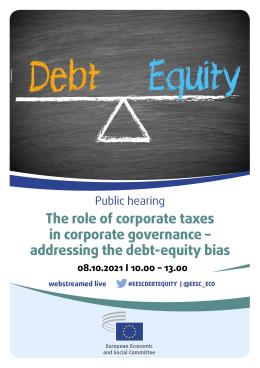
In order to reshape the European economy and in line with the objectives stated by the European Commission for a more sustainable, greener and digitalised economy, investments must support environmental goals and remove obstacles to corporate dividend policymaking and payments. Among many other factors, the debt-equity bias in the corporate tax systems affects both the leverage of firms and corporate governance. The EESC welcomes the recent public consultation on a new initiative to mitigate the debt-equity bias in corporate taxation launched by the European Commission and shares the Commission's view that companies should contribute to the achievement of a greener, sustainable and digitalised economy.
The EESC aspires to contribute to the ongoing public debate andwill hold an online public hearing ‘’The role of corporate taxes in corporate governance - addressing the debt-equity bias" on 8 October 2021. The event is accessible via webstream. No registration is needed and participation is free of charge.
In the process of rapid transformation of the economy and businesses, digitalisation has taken on a key strategic role, to the point of becoming pervasive across all sectors of activity, and affecting the entire cycle of the product and service value chain, involving both large companies and small and micro enterprises. The consequences for the world of work, in terms of new opportunities and new challenges, are significant as regards both their nature and the speed of change.
Energy poverty is high at the EESC's agenda as more Europeans may struggle to afford access to essential energy, particularly with rising energy costs.
The European Commission published on 14th July 2021 a proposal for reviewing the EU Directive on Energy Efficiency, aimed at further stimulating EU efforts to promote energy efficiency and achieve energy savings in the fight against climate change. The proposal forms part of the Fit for 55 package.
The aim of the hearing is to exchange views with experts from public and private sector on the review of the Energy Efficiency Directive put forward by the European Commission. The event also serves as a source of inspiration for the preparation of the EESC opinion on the Review of the Energy Efficiency Directive.
The conference "The Anti-Money Laundering Legislative Package" will take stock of the state of play and debate in particular the legislative proposals tabled by the European Commission in July 2021 to strengthen the EU's anti-money laundering and countering terrorism financing (AML/CFT) rules.
The conference is organised on 5 October 2021, starting at 14:30.
The event is accessible via webstream. No registration is needed, and participation is free of charge.
The fourth conference of the Social Innovation for Refugee Inclusion (SI4RI) builds on previous editions in 2016, 2017 and 2019.The 2021 conference will explore in particular how the diverse landscape of partnerships, social enterprises, participatory models, and community led initiatives spearheading social innovation for inclusion have fared against the backdrop of COVID 19. It will also discuss how this ecosystem can emerge strengthened from the crisis, and how innovations can reach underserved places and highly vulnerable groups.
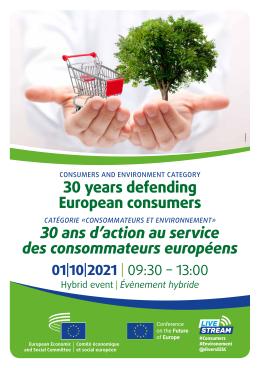
On 1 October the Category will mark its 30th anniversary, with high-profile speakers and round tables. The event is organised in the context of the Conference on the Future of Europe.
Topics on the agenda: how to enhance the accession process – a credible EU perspective for the Western Balkans; the contribution of CSOs to the Green Agenda and sustainable development of the Western Balkans as part of the EU accession process; the state of social dialogue, as well as enabling civic space in the Western Balkans. @EESC_REX #EESC_WB
This event aims to raise awareness among policymakers and other stakeholders of the important contribution of community/grassroots initiatives to global goals and to navigating social, environmental and economic changes in support of wider transformation.