European Economic
and Social Committee
European Economic
and Social Committee
The European Economic and Social Committee (EESC) is the voice of organised civil society in Europe.
Find out more about its role and structure at http://www.eesc.europa.eu/en/about
The EESC issues between 160 and 190 opinions, evaluation and information reports a year.
It also organises several annual initiatives and events with a focus on civil society and citizens’ participation such as the Civil Society Prize, the Civil Society Days, the Your Europe, Your Say youth plenary and the ECI Day.
Find the latest EESC opinions and publications at http://www.eesc.europa.eu/en/our-work/opinions-information-reports/opinions and http://www.eesc.europa.eu/en/our-work/publications-other-work/publications respectively.
The EESC is active in a wide range of areas, from social affairs to economy, energy and sustainability.
Learn more about our policy areas and policy highlights at http://www.eesc.europa.eu/en/policies
The EESC holds nine plenary sessions per year. It also organises many conferences, public hearings and high-level debates related to its work.
Find out more about our upcoming events at http://www.eesc.europa.eu/en/agenda/our-events/upcoming-events
Here you can find news and information about the EESC'swork, including its social media accounts, the EESC Info newsletter, photo galleries and videos.
Read the latest EESC news http://www.eesc.europa.eu/en/news-media/news and press releases http://www.eesc.europa.eu/en/news-media/press-releases
The EESC brings together representatives from all areas of organised civil society, who give their independent advice on EU policies and legislation. The EESC's326 Members are organised into three groups: Employers, Workers and Various Interests.
Find out more about our Members and groups at http://www.eesc.europa.eu/en/members-groups
The EESC has six sections, specialising in concrete topics of relevance to the citizens of the European Union, ranging from social to economic affairs, energy, environment, external relations or the internal market.
Find out more at http://www.eesc.europa.eu/en/sections-other-bodies
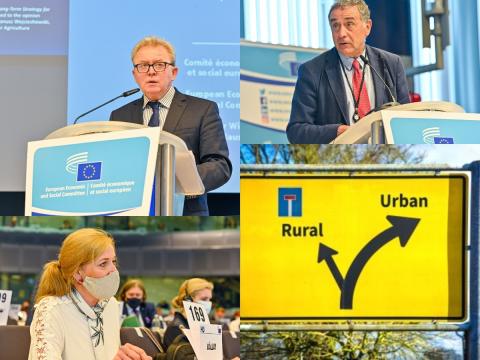
EHSV vyzýva tvorcov politiky, aby uplatňovali komplexnú a holistickú stratégiu EÚ, ktorá bude podporovať vyvážený, súdržný, spravodlivý a udržateľný rozvoj vidieka a miest. To bude zahŕňať využitie úlohy miestnych komunít, podporu tradičných odvetví a vytváranie nových hospodárskych činností a pracovných miest vo vidieckych oblastiach, ako aj väčšiu súčinnosť s mestskými oblasťami.
Stanovisko EHSV na tému Smerom ku komplexnej stratégii udržateľného rozvoja vidieka a miest obsahuje niekoľko odporúčaní založených na zapojení viacerých zainteresovaných strán a prístupe „zdola nahor“, čo má kľúčový význam pre zabezpečenie udržateľnosti politík rozvoja vidieka a miestnej zodpovednosti za ne.
Horizontálna koordinácia a prispôsobené politiky majú zásadný význam
„Je potrebné zaujať integrovaný prístup k opatreniam a financovaniu v rámci rôznych politík, ktoré majú vplyv na vidiecke oblasti. Je nevyhnutné je zaistiť, aby vidiecke oblasti boli nielen udržateľné, ale aj príťažlivé miesta na život. Kvalita života na vidieku sa bude merať podľa nárastu podielu mladých ľudí na miestnom obyvateľstve a nových iniciatív, ktoré poskytujú kvalitné a dobre platené pracovné miesta“, zdôraznil spravodajca Josep Puxeu Rocamora. (mr)