European Economic
and Social Committee
European Economic
and Social Committee
The European Economic and Social Committee (EESC) is the voice of organised civil society in Europe.
Find out more about its role and structure at http://www.eesc.europa.eu/en/about
The EESC issues between 160 and 190 opinions, evaluation and information reports a year.
It also organises several annual initiatives and events with a focus on civil society and citizens’ participation such as the Civil Society Prize, the Civil Society Days, the Your Europe, Your Say youth plenary and the ECI Day.
Find the latest EESC opinions and publications at http://www.eesc.europa.eu/en/our-work/opinions-information-reports/opinions and http://www.eesc.europa.eu/en/our-work/publications-other-work/publications respectively.
The EESC is active in a wide range of areas, from social affairs to economy, energy and sustainability.
Learn more about our policy areas and policy highlights at http://www.eesc.europa.eu/en/policies
The EESC holds nine plenary sessions per year. It also organises many conferences, public hearings and high-level debates related to its work.
Find out more about our upcoming events at http://www.eesc.europa.eu/en/agenda/our-events/upcoming-events
Here you can find news and information about the EESC'swork, including its social media accounts, the EESC Info newsletter, photo galleries and videos.
Read the latest EESC news http://www.eesc.europa.eu/en/news-media/news and press releases http://www.eesc.europa.eu/en/news-media/press-releases
The EESC brings together representatives from all areas of organised civil society, who give their independent advice on EU policies and legislation. The EESC's326 Members are organised into three groups: Employers, Workers and Various Interests.
Find out more about our Members and groups at http://www.eesc.europa.eu/en/members-groups
The EESC has six sections, specialising in concrete topics of relevance to the citizens of the European Union, ranging from social to economic affairs, energy, environment, external relations or the internal market.
Find out more at http://www.eesc.europa.eu/en/sections-other-bodies
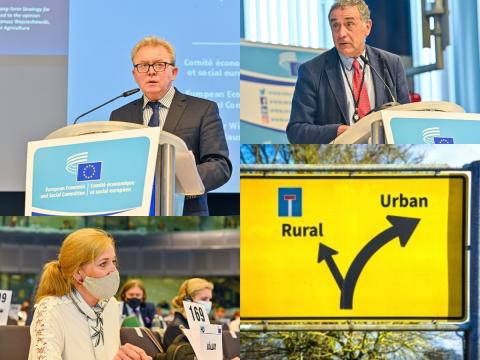
Le CESE demande aux responsables politiques de mettre en œuvre une stratégie globale et intégrée propice à un développement rural et urbain équilibré, cohérent, équitable et durable. Il s’agira ce faisant de valoriser le rôle des collectivités locales, de stimuler les industries traditionnelles et de créer des activités économiques et des possibilités d’emploi nouvelles dans les zones rurales, tout en favorisant les synergies avec les zones urbaines.
L’avis du CESE sur le thème «Vers une stratégie globale en matière de développement rural et urbain durable» contient plusieurs recommandations formulées sur la base d’une «participation à la démarche de divers acteurs intéressés» et d’une «approche ascendante», qui sont des ingrédients essentiels pour garantir la durabilité et une appropriation locale des politiques rurales.
Une coordination transversale et des actions sur mesure sont essentielles
«Il est crucial d’avancer vers une approche intégrée de l’action et du financement dans les différentes politiques qui ont une incidence sur les zones rurales. Il faut faire en sorte que les zones rurales soient non seulement durables, mais aussi des lieux de vie attrayants. La qualité de vie dans le monde rural se mesurera à l’aune de l’augmentation du nombre de jeunes et de nouvelles initiatives pourvoyeuses d’emplois de qualité et bien rémunérés», a souligné le rapporteur Josep Puxeu Rocamora. (mr)