European Economic
and Social Committee
European Economic
and Social Committee
The European Economic and Social Committee (EESC) is the voice of organised civil society in Europe.
Find out more about its role and structure at http://www.eesc.europa.eu/en/about
The EESC issues between 160 and 190 opinions, evaluation and information reports a year.
It also organises several annual initiatives and events with a focus on civil society and citizens’ participation such as the Civil Society Prize, the Civil Society Days, the Your Europe, Your Say youth plenary and the ECI Day.
Find the latest EESC opinions and publications at http://www.eesc.europa.eu/en/our-work/opinions-information-reports/opinions and http://www.eesc.europa.eu/en/our-work/publications-other-work/publications respectively.
The EESC is active in a wide range of areas, from social affairs to economy, energy and sustainability.
Learn more about our policy areas and policy highlights at http://www.eesc.europa.eu/en/policies
The EESC holds nine plenary sessions per year. It also organises many conferences, public hearings and high-level debates related to its work.
Find out more about our upcoming events at http://www.eesc.europa.eu/en/agenda/our-events/upcoming-events
Here you can find news and information about the EESC'swork, including its social media accounts, the EESC Info newsletter, photo galleries and videos.
Read the latest EESC news http://www.eesc.europa.eu/en/news-media/news and press releases http://www.eesc.europa.eu/en/news-media/press-releases
The EESC brings together representatives from all areas of organised civil society, who give their independent advice on EU policies and legislation. The EESC's326 Members are organised into three groups: Employers, Workers and Various Interests.
Find out more about our Members and groups at http://www.eesc.europa.eu/en/members-groups
The EESC has six sections, specialising in concrete topics of relevance to the citizens of the European Union, ranging from social to economic affairs, energy, environment, external relations or the internal market.
Find out more at http://www.eesc.europa.eu/en/sections-other-bodies
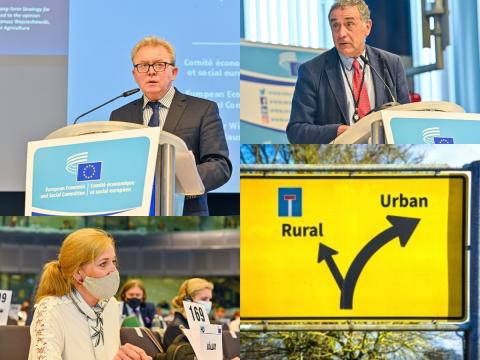
Der EWSA fordert die politischen Entscheidungsträger auf, eine umfassende und ganzheitliche Strategie für eine ausgewogene, kohärente, gerechte und nachhaltige ländliche und städtische Entwicklung umzusetzen. Dies erfordert die Stärkung der Rolle der lokalen Gemeinschaften, die Förderung traditioneller Wirtschaftszweige und die Schaffung neuer Wirtschaftstätigkeiten und Beschäftigungsmöglichkeiten auf dem Land bei gleichzeitiger Förderung von Synergien mit städtischen Gebieten.
Der EWSA spricht in seiner Stellungnahme „Eine ganzheitliche Strategie für nachhaltige ländliche und städtische Entwicklung“ mehrere Empfehlungen aus, die sich auf die Einbeziehung verschiedener Interessenträger und einen „Bottom-up“-Ansatz als wesentliche Voraussetzungen für eine nachhaltige Politik des ländlichen Raums und die Eigenverantwortung der lokalen Ebene für diese Politik stützen.
Ausschlaggebend sind eine horizontale Koordinierung und maßgeschneiderte Maßnahmen.
„Bei den verschiedenen Maßnahmen mit Auswirkungen auf den ländlichen Raum ist ein integrierter Handlungs- und Finanzierungsansatz erforderlich. Es muss dafür gesorgt werden, dass ländliche Gebiete nicht nur zukunftsfähig, sondern auch lebenswert sind. Die Lebensqualität in den ländlichen Gebieten wird sich an der Zahl neu zugezogener junger Menschen und neuer Initiativen für hochwertige, gut bezahlte Arbeitsplätze messen lassen“, betonte Berichterstatter Josep Puxeu Rocamora. (mr)