European Economic
and Social Committee
European Economic
and Social Committee
The European Economic and Social Committee (EESC) is the voice of organised civil society in Europe.
Find out more about its role and structure at http://www.eesc.europa.eu/en/about
The EESC issues between 160 and 190 opinions, evaluation and information reports a year.
It also organises several annual initiatives and events with a focus on civil society and citizens’ participation such as the Civil Society Prize, the Civil Society Days, the Your Europe, Your Say youth plenary and the ECI Day.
Find the latest EESC opinions and publications at http://www.eesc.europa.eu/en/our-work/opinions-information-reports/opinions and http://www.eesc.europa.eu/en/our-work/publications-other-work/publications respectively.
The EESC is active in a wide range of areas, from social affairs to economy, energy and sustainability.
Learn more about our policy areas and policy highlights at http://www.eesc.europa.eu/en/policies
The EESC holds nine plenary sessions per year. It also organises many conferences, public hearings and high-level debates related to its work.
Find out more about our upcoming events at http://www.eesc.europa.eu/en/agenda/our-events/upcoming-events
Here you can find news and information about the EESC'swork, including its social media accounts, the EESC Info newsletter, photo galleries and videos.
Read the latest EESC news http://www.eesc.europa.eu/en/news-media/news and press releases http://www.eesc.europa.eu/en/news-media/press-releases
The EESC brings together representatives from all areas of organised civil society, who give their independent advice on EU policies and legislation. The EESC's326 Members are organised into three groups: Employers, Workers and Various Interests.
Find out more about our Members and groups at http://www.eesc.europa.eu/en/members-groups
The EESC has six sections, specialising in concrete topics of relevance to the citizens of the European Union, ranging from social to economic affairs, energy, environment, external relations or the internal market.
Find out more at http://www.eesc.europa.eu/en/sections-other-bodies
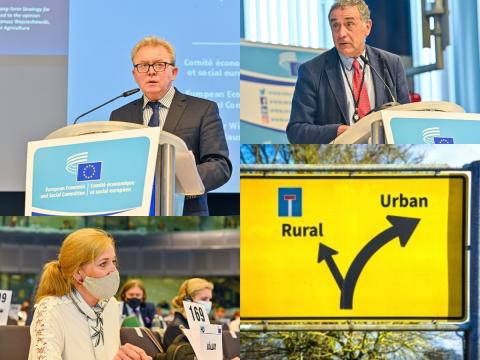
EESO poziva oblikovalce politik, naj izvedejo celovito in celostno strategijo za spodbujanje uravnoteženega, skladnega, pravičnega in trajnostnega razvoja podeželja in mest. Ta mora med drugim izkoristiti vlogo lokalnih skupnosti, spodbujati tradicionalne sektorje ter ustvarjati nove gospodarske dejavnosti in priložnosti za delo na podeželskih območjih ob hkratni krepitvi sinergije z mestnimi območji.
EESO v svojem mnenju Za celostno strategijo za trajnostni razvoj podeželja in mest podaja mnogo priporočil, temelječih na sodelovanju številnih deležnikov in pristopu od spodaj navzgor, ki sta ključna elementa za zagotavljanje trajnostnosti in lokalne odgovornosti za podeželske politike.
Horizontalno usklajevanje in prilagojene politike so ključnega pomena
„Pri ukrepanju in financiranju na področjih različnih politik, ki imajo vpliv na podeželska območja, je bistveno preiti na povezan pristop. Zagotoviti je treba, da podeželska območja ne bodo le trajnosten, ampak tudi privlačen kraj za življenje. Kakovost življenja na podeželju bo mogoče izmeriti na podlagi povečanja števila mladih in novih pobud, ki prinašajo kakovostna in dobro plačana delovna mesta,“ je poudaril poročevalec Josep Puxeu Rocamora. (mr)