European Economic
and Social Committee
European Economic
and Social Committee
The European Economic and Social Committee (EESC) is the voice of organised civil society in Europe.
Find out more about its role and structure at http://www.eesc.europa.eu/en/about
The EESC issues between 160 and 190 opinions, evaluation and information reports a year.
It also organises several annual initiatives and events with a focus on civil society and citizens’ participation such as the Civil Society Prize, the Civil Society Days, the Your Europe, Your Say youth plenary and the ECI Day.
Find the latest EESC opinions and publications at http://www.eesc.europa.eu/en/our-work/opinions-information-reports/opinions and http://www.eesc.europa.eu/en/our-work/publications-other-work/publications respectively.
The EESC is active in a wide range of areas, from social affairs to economy, energy and sustainability.
Learn more about our policy areas and policy highlights at http://www.eesc.europa.eu/en/policies
The EESC holds nine plenary sessions per year. It also organises many conferences, public hearings and high-level debates related to its work.
Find out more about our upcoming events at http://www.eesc.europa.eu/en/agenda/our-events/upcoming-events
Here you can find news and information about the EESC'swork, including its social media accounts, the EESC Info newsletter, photo galleries and videos.
Read the latest EESC news http://www.eesc.europa.eu/en/news-media/news and press releases http://www.eesc.europa.eu/en/news-media/press-releases
The EESC brings together representatives from all areas of organised civil society, who give their independent advice on EU policies and legislation. The EESC's326 Members are organised into three groups: Employers, Workers and Various Interests.
Find out more about our Members and groups at http://www.eesc.europa.eu/en/members-groups
The EESC has six sections, specialising in concrete topics of relevance to the citizens of the European Union, ranging from social to economic affairs, energy, environment, external relations or the internal market.
Find out more at http://www.eesc.europa.eu/en/sections-other-bodies
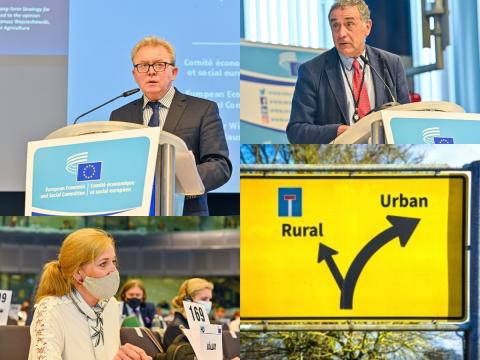
Tá CESE ag iarraidh ar lucht déanta beartas straitéis chuimsitheach iomlánaíoch a chur chun feidhme maidir le forbairt tuaithe agus uirbeach atá cothrom, comhtháite, comhionann agus inbhuanaithe. Is éard atá i gceist leis seo leas a bhaint as ról na bpobal áitiúil, borradh a chur faoi thionscail thraidisiúnta agus gníomhaíochtaí eacnamaíocha agus deiseanna fostaíochta nua a chruthú i gceantair thuaithe, agus sineirgí le limistéir uirbeacha á gcothú ag an am céanna.
Sa tuairim ó CESE I dtreo straitéis iomlánaíoch maidir le forbairt inbhuanaithe tuaithe/uirbeach, déantar roinnt moltaí atá bunaithe ar rannpháirtíocht il-gheallsealbhóra agus cur chuige 'ó bhun aníos’, gnéithe atá ríthábhachtach chun inbhuanaitheacht agus úinéireacht áitiúil na mbeartas tuaithe a áirithiú.
An ríthábhacht a bhaineann le comhordú cothrománach agus beartais shaincheaptha
‘Tá sé riachtanach bogadh i dtreo cur chuige atá comhtháite maidir le gníomhaíocht agus cistiú na mbeartas éagsúil a bhfuil tionchar acu ar cheantair thuaithe. Ní mór a áirithiú ní hamháin gur áiteanna inbhuanaithe iad na ceantair thuaithe ach gur áiteanna tarraingteacha iad freisin le cónaí iontu. Is leis an méadú a thagann ar líon na ndaoine óga agus ar thionscnaimh nua a chuireann poist dhea-íoctha ar ardcháilíocht ar fáil, a dhéanfar caighdeán saoil i gceantair thuaithe a thomhas’, a dúirt an rapóirtéir Josep Puxeu Rocamora. (an tUas.)