
European Economic
and Social Committee
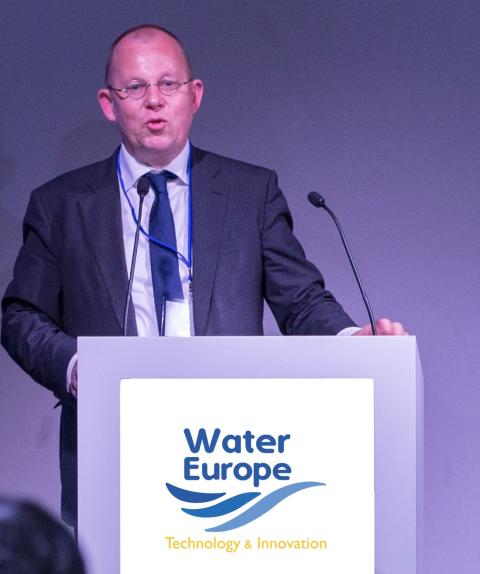
For Water Europe – the EU’s leading platform promoting innovation and cooperation in the European water sector – the European Commission’s newly unveiled Water Resilience Strategy is not just another policy document: it represents a pivotal acknowledgment that water is becoming a central pillar of Europe’s future, writes Water Europe’s Executive Director Durk Krol.
The new Water Resilience Strategy is built in part on the Water Europe community’s longstanding and persistent commitment and mobilisation. Through continuous advocacy, co-creation – anchored in our network of water-oriented living labs and aligned with European initiatives such as the Water4All Partnership – and sustained efforts to build political momentum, we have helped make this vision a reality. Since launching our position on the EU Blue Deal and publishing our manifesto for the 2024 EU elections, we have consistently called for a European Water Strategy, a dedicated Commissioner for Water, and a dedicated Water Fund in the next Multiannual Financial Framework (MFF). We have actively contributed to the positions of the European Economic and Social Committee, collaborated closely with Members of the European Parliament, and formed a coalition of over 30 organisations to urge the Commission to maintain its commitment to water resilience.
Today, this strategy sends a clear and urgent signal: Europe’s water resilience is non-negotiable. As droughts intensify, pollutants accumulate and competition for water grows, particularly in industry and agriculture, it is no longer possible to treat water as a passive resource. The strategy’s ambitions to guarantee clean, affordable water for all, accelerate investment in infrastructure and integrate water into the Green and Digital transitions reflect a shift in mindset that is both necessary and overdue.
One of the most transformative aspects of the strategy is its embrace of the water-smart economy, a concept that Water Europe has long championed. The economic sectors with the highest water abstraction levels also have the potential to save the most water (EEA, 2025), with several benefits for their activities:
- Critical industries – hydrogen, batteries, semiconductors and data centres – are projected to triple their water consumption by 2030, growing from €192 billion today to nearly €1 trillion (Water Europe, 2024).
- With 29% of the EU’s territory already experiencing water scarcity, this poses a serious threat to our competitiveness and strategic autonomy (EEA, 2019).
- Europe’s water infrastructure is also under pressure. Meeting existing EU water legislation alone requires at least €255 billion in investment to ensure water and sanitation for our society (Water Europe, 2024).
A water-smart economy should be understood as the economic dimension of a water-smart society. It implements the societal vision by embedding the value of water into how we grow, produce, invest and innovate. Together, a water-smart economy and society represent a holistic model where social equity, environmental integrity and economic vitality are interdependent drivers of water resilience.
Although the strategy signals an important transition, this transformation won’t happen without dedicated financial instruments. Our new white paper on water financing shows that a water-smart economy is not a concept, it’s a financial imperative. By recognising water’s value across key sectors, Europe can unlock nearly €1 trillion in added value by 2030. At the same time, investment in water will help utilities close the €255 billion funding gap needed to comply with EU standards.
Water resilience must not be seen as a niche concern but as the linchpin for Europe’s energy transition, food security and industrial leadership.
The strategy takes an important step forward by recognising the transformative potential of digitalisation, water efficiency, reuse, public procurement and research & innovation. We particularly welcome the announcement of a Water Resilience R&I strategy to address the fragmentation of EU R&I initiatives, as well as the Digitalisation Action Plan, aimed at ensuring data transparency, interoperability and harmonised methodologies across Europe.
Water Europe reaffirms its readiness to support the Commission, Member States and local actors in translating the Water Resilience Strategy into tangible progress for citizens, ecosystems and economic actors. We stand ready to help turn this strategy into action. In doing so, we support the regional deployment of innovative solutions and help close the gap between EU ambitions and local realities.
Durk Krol is Executive Director at Water Europe, a Brussels-based non-profit organisation that acts as the pan-European voice and promoter of water-related innovation, research and technology development. Water Europe focuses on the entire water value chain and advocates creating a water-secure, sustainable and resilient water-smart society in Europe and beyond. Water Europe took part in the EESC Consumer Day dedicated to water, held in December 2024.