
European Economic
and Social Committee
EESC study provides tools to improve EU measures against intergenerational poverty
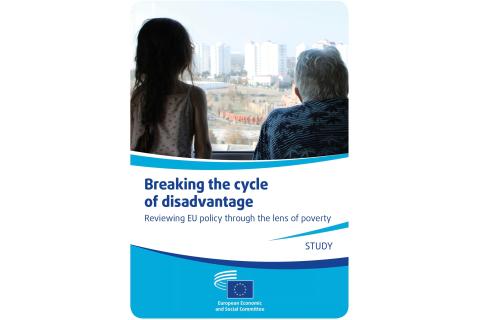
A new study by the European Economic and Social Committee (EESC) highlights the intergenerational aspect of poverty and presents an evidence-based definition of this phenomenon based on ten key drivers. It examines how EU policy addresses these factors and identifies areas where further action is needed, particularly with regard to parental education levels and family stability.
The study on Breaking the cycle of disadvantage - Reviewing EU policy through the lens of poverty is being published ahead of the International Day for the Eradication of Poverty and in the context of the first-ever European Anti-Poverty Strategy, presented by the European Commission in May 2026.
Cillian Lohan, President of the Civil Society Organisations' Group, which requested the study, said: With this study, we draw attention to the deep-rooted factors that perpetuate poverty over one’s life course and across generations, something we call 'Intergenerational poverty'. The EU must strongly support Member States’ efforts to combat poverty and ensure that policies reach local communities. Civil society, drawing on its longstanding commitment and expertise, stands ready to contribute.
The EESC study identifies ten key drivers of intergenerational poverty and analyses how 32 selected EU policy instruments address them and could be improved. It highlights the importance of examining parental education levels and family stability and proposes an evidence-based definition of intergenerational poverty.
The European Anti-Poverty Strategy emphasises that 'new investments and reforms need to (be) poverty-proof'. The EESC study provides a novel research framework that could help the European institutions assess the potential impact of future policies on intergenerational poverty from the earliest stages of policy design. It also offers valuable insights for shaping the EU's next long-term budget (2028-2034), which is currently still under negotiation.
The EESC's Civil Society Organisations' Group and the EESC have long been active in addressing the issue of poverty and the EESC is preparing to sign a Memorandum of Understanding on the first-ever European Anti-Poverty Strategy between its President, Séamus Boland, and European Commission Vice-President, Roxana Mînzatu. This study reflects and complements the EESC's commitment to work towards eradicating poverty. The EESC will shortly deliver its views on the proposals for an Anti-Poverty Strategy, on strengthening the EU Child Guarantee, and on the role of civil society in Europe’s fight against poverty.
The Group remains committed to the fight against poverty by advocating policies that support and empower communities, in line with the Agenda for Sustainable Development, which lies at the heart of its work programme for the 2025-2028 term.
Background:
Forthcoming highlights of the EESC's activities on eradicating poverty in 2026 include:
- High-level debate: The EESC will hold a debate on Eradicating Poverty by 2050: fulfilling our collective responsibility at its October plenary session on 22 October 2026 at 10.00 (CEST). EESC President, Séamus Boland, and European Commission Vice-President, Roxana Mînzatu, will sign a Memorandum of Understanding on the European Anti-Poverty Strategy.
- 16th EESC Civil Society Prize: The prize will reward excellence in civil society initiatives on Combating poverty in the EU. The deadline for applications is 6 November 2026 at 10.00 (CET).
- Expected presentation of and vote on related EESC opinions at the October plenary session on 21-22 October 2026:
- Shrinking democratic space as a barrier to achieving the Sustainable Development Goals in the European Union – placing civil society at the heart of Europe’s fight against poverty (SDG1) (Own-initiative opinion SOC/865)
- Strengthening the child guarantee (Opinion SOC/872)
- Anti-poverty strategy and inter-generational poverty (Exploratory opinion at the request of the Irish Presidency of the EU SOC/875)
Further information on the study can be found in an interview with the authors or on our dedicated website, which also includes an executive summary.
Work organisation
Related content


Downloads
-
PR: EESC study provides tools to improve EU measures against intergenerational poverty
Recommended for you
YEYS! 2023: Jongeren vragen een EU die transparanter, digitaler en eenvoudiger is
News
Op 23 en 24 maart is bij het Europees Economisch en Sociaal Comité (EESC) de veertiende editie van Jouw Europa, jouw mening! (YEYS!) gehouden. Voor dat evenement kwamen 105 leerlingen van 35 scholen…
De elektriciteitsmarkt van de EU moet worden hervormd
News
Uit een door het Europees Economisch en Sociaal Comité (EESC) georganiseerd debat kwam naar voren dat het van cruciaal belang is de Europese elektriciteitsmarkt aan te passen om de zwakke punten…
Kandidaten kunnen zich nu aanmelden voor de EESC-prijs voor het maatschappelijk middenveld, die dit jaar geestelijke gezondheid als thema heeft
News
Maatschappelijke organisaties, individuen en particuliere ondernemingen kunnen nu met hun non-profitprojecten meedingen naar de EESC-prijs voor het maatschappelijk middenveld, die deze keer in het…
EESC roept de EU-burgers op om in juni 2024 te stemmen voor een verenigd en democratisch Europa
News
Tegen de achtergrond van een wereldwijde achteruitgang van de democratie, welig tierende desinformatie, groeiende ontevredenheid, stijgende inflatie en oorlogsdreiging, staat er veel op het spel bij…
De sociale en burgerdialoog kunnen de EU helpen duurzaam te groeien
News
Slechts enkele dagen na de Europese verkiezingen van 2024 kwamen het Europees Economisch en Sociaal Comité (EESC) en de nationale sociaal-economische raden van de EU bijeen om de stand van zaken van…