
European Economic
and Social Committee
EESC study provides tools to improve EU measures against intergenerational poverty
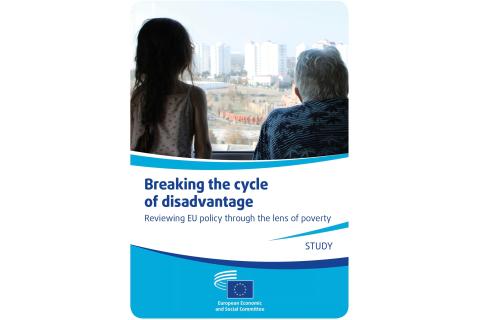
A new study by the European Economic and Social Committee (EESC) highlights the intergenerational aspect of poverty and presents an evidence-based definition of this phenomenon based on ten key drivers. It examines how EU policy addresses these factors and identifies areas where further action is needed, particularly with regard to parental education levels and family stability.
The study on Breaking the cycle of disadvantage - Reviewing EU policy through the lens of poverty is being published ahead of the International Day for the Eradication of Poverty and in the context of the first-ever European Anti-Poverty Strategy, presented by the European Commission in May 2026.
Cillian Lohan, President of the Civil Society Organisations' Group, which requested the study, said: With this study, we draw attention to the deep-rooted factors that perpetuate poverty over one’s life course and across generations, something we call 'Intergenerational poverty'. The EU must strongly support Member States’ efforts to combat poverty and ensure that policies reach local communities. Civil society, drawing on its longstanding commitment and expertise, stands ready to contribute.
The EESC study identifies ten key drivers of intergenerational poverty and analyses how 32 selected EU policy instruments address them and could be improved. It highlights the importance of examining parental education levels and family stability and proposes an evidence-based definition of intergenerational poverty.
The European Anti-Poverty Strategy emphasises that 'new investments and reforms need to (be) poverty-proof'. The EESC study provides a novel research framework that could help the European institutions assess the potential impact of future policies on intergenerational poverty from the earliest stages of policy design. It also offers valuable insights for shaping the EU's next long-term budget (2028-2034), which is currently still under negotiation.
The EESC's Civil Society Organisations' Group and the EESC have long been active in addressing the issue of poverty and the EESC is preparing to sign a Memorandum of Understanding on the first-ever European Anti-Poverty Strategy between its President, Séamus Boland, and European Commission Vice-President, Roxana Mînzatu. This study reflects and complements the EESC's commitment to work towards eradicating poverty. The EESC will shortly deliver its views on the proposals for an Anti-Poverty Strategy, on strengthening the EU Child Guarantee, and on the role of civil society in Europe’s fight against poverty.
The Group remains committed to the fight against poverty by advocating policies that support and empower communities, in line with the Agenda for Sustainable Development, which lies at the heart of its work programme for the 2025-2028 term.
Background:
Forthcoming highlights of the EESC's activities on eradicating poverty in 2026 include:
- High-level debate: The EESC will hold a debate on Eradicating Poverty by 2050: fulfilling our collective responsibility at its October plenary session on 22 October 2026 at 10.00 (CEST). EESC President, Séamus Boland, and European Commission Vice-President, Roxana Mînzatu, will sign a Memorandum of Understanding on the European Anti-Poverty Strategy.
- 16th EESC Civil Society Prize: The prize will reward excellence in civil society initiatives on Combating poverty in the EU. The deadline for applications is 6 November 2026 at 10.00 (CET).
- Expected presentation of and vote on related EESC opinions at the October plenary session on 21-22 October 2026:
- Shrinking democratic space as a barrier to achieving the Sustainable Development Goals in the European Union – placing civil society at the heart of Europe’s fight against poverty (SDG1) (Own-initiative opinion SOC/865)
- Strengthening the child guarantee (Opinion SOC/872)
- Anti-poverty strategy and inter-generational poverty (Exploratory opinion at the request of the Irish Presidency of the EU SOC/875)
Further information on the study can be found in an interview with the authors or on our dedicated website, which also includes an executive summary.
Work organisation
Related content


Downloads
-
PR: EESC study provides tools to improve EU measures against intergenerational poverty
Recommended for you
Az egészségügyi ágazatbeli közszolgáltatások közös létrehozása erősíteni fogja a demokrácia részvételi jellegét az EU-ban
News
Az Európai Gazdasági és Szociális Bizottság (EGSZB) és a Debreceni Egyetem által szervezett rendezvény rávilágított, mennyire fontos az általános érdekű szolgáltatások közös létrehozása az…
YEYS! 2023: A fiatalok átláthatóbb, digitalizált és egyszerűbb EU-t szeretnének
News
Március 23-án és 24-én az Európai Gazdasági és Szociális Bizottság (EGSZB) immár 14. alkalommal adott otthont a „Your Europe, Your Say!” (A Te Európád, a Te szavad! – YEYS!) című rendezvénynek. Erre…
Az EGSZB megnyitja a jelentkezést civil társadalmi díjára, melynek témája a mentális egészség
News
Civil társadalmi szervezetek, magánszemélyek és magánvállalkozások mostantól nevezhetik nonprofit projektjeiket az európai polgárok mentális jólétének támogatásának szentelt EGSZB-díjra. Az Európai…
Az EGSZB felhívása: 2024 júniusában szavazzunk egy egységes és demokratikus Európai Unióra!
News
A demokrácia világszerte hanyatlik, a növekvő infláció és a háború fenyegető veszélye közepette a dezinformáció térnyerése és egyre nagyobb elégedetlenség tapasztalható. Nagy tehát a tétje az új…
Az Európai Gazdasági és Szociális Bizottság készen áll arra, hogy együttműködjön az EU Tanácsának magyar elnökségével
News
Az Európai Gazdasági és Szociális Bizottság (EGSZB) júliusi plenáris ülésén Oliver Röpke EGSZB-elnök vitát tartott Bóka János európai uniós ügyekért felelős miniszterrel, aki ismertette az EU Tanácsa…