
European Economic
and Social Committee
EESC study provides tools to improve EU measures against intergenerational poverty
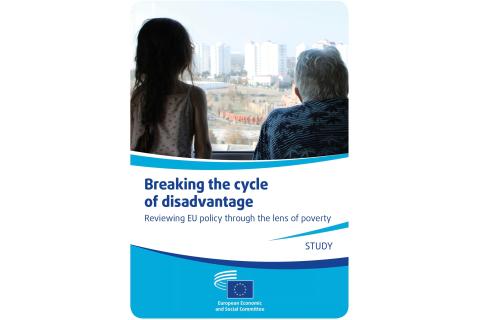
A new study by the European Economic and Social Committee (EESC) highlights the intergenerational aspect of poverty and presents an evidence-based definition of this phenomenon based on ten key drivers. It examines how EU policy addresses these factors and identifies areas where further action is needed, particularly with regard to parental education levels and family stability.
The study on Breaking the cycle of disadvantage - Reviewing EU policy through the lens of poverty is being published ahead of the International Day for the Eradication of Poverty and in the context of the first-ever European Anti-Poverty Strategy, presented by the European Commission in May 2026.
Cillian Lohan, President of the Civil Society Organisations' Group, which requested the study, said: With this study, we draw attention to the deep-rooted factors that perpetuate poverty over one’s life course and across generations, something we call 'Intergenerational poverty'. The EU must strongly support Member States’ efforts to combat poverty and ensure that policies reach local communities. Civil society, drawing on its longstanding commitment and expertise, stands ready to contribute.
The EESC study identifies ten key drivers of intergenerational poverty and analyses how 32 selected EU policy instruments address them and could be improved. It highlights the importance of examining parental education levels and family stability and proposes an evidence-based definition of intergenerational poverty.
The European Anti-Poverty Strategy emphasises that 'new investments and reforms need to (be) poverty-proof'. The EESC study provides a novel research framework that could help the European institutions assess the potential impact of future policies on intergenerational poverty from the earliest stages of policy design. It also offers valuable insights for shaping the EU's next long-term budget (2028-2034), which is currently still under negotiation.
The EESC's Civil Society Organisations' Group and the EESC have long been active in addressing the issue of poverty and the EESC is preparing to sign a Memorandum of Understanding on the first-ever European Anti-Poverty Strategy between its President, Séamus Boland, and European Commission Vice-President, Roxana Mînzatu. This study reflects and complements the EESC's commitment to work towards eradicating poverty. The EESC will shortly deliver its views on the proposals for an Anti-Poverty Strategy, on strengthening the EU Child Guarantee, and on the role of civil society in Europe’s fight against poverty.
The Group remains committed to the fight against poverty by advocating policies that support and empower communities, in line with the Agenda for Sustainable Development, which lies at the heart of its work programme for the 2025-2028 term.
Background:
Forthcoming highlights of the EESC's activities on eradicating poverty in 2026 include:
- High-level debate: The EESC will hold a debate on Eradicating Poverty by 2050: fulfilling our collective responsibility at its October plenary session on 22 October 2026 at 10.00 (CEST). EESC President, Séamus Boland, and European Commission Vice-President, Roxana Mînzatu, will sign a Memorandum of Understanding on the European Anti-Poverty Strategy.
- 16th EESC Civil Society Prize: The prize will reward excellence in civil society initiatives on Combating poverty in the EU. The deadline for applications is 6 November 2026 at 10.00 (CET).
- Expected presentation of and vote on related EESC opinions at the October plenary session on 21-22 October 2026:
- Shrinking democratic space as a barrier to achieving the Sustainable Development Goals in the European Union – placing civil society at the heart of Europe’s fight against poverty (SDG1) (Own-initiative opinion SOC/865)
- Strengthening the child guarantee (Opinion SOC/872)
- Anti-poverty strategy and inter-generational poverty (Exploratory opinion at the request of the Irish Presidency of the EU SOC/875)
Further information on the study can be found in an interview with the authors or on our dedicated website, which also includes an executive summary.
Work organisation
Related content


Downloads
-
PR: EESC study provides tools to improve EU measures against intergenerational poverty
Recommended for you
Toghadh Séamus Boland ina Uachtarán ar Choiste Eacnamaíoch agus Sóisialta na hEorpa, agus gheall sé go gcuirfear an tsochaí shibhialta i gcroílár na hEorpa
News
Toghadh Séamus Boland na hÉireann ar an 35ú Uachtarán ar Choiste Eacnamaíoch agus Sóisialta na hEorpa (CESE) le haghaidh an téarma oifige 2025-2028. Is urlabhra riamh anall é do phobail na tuaithe…
CESE, Uachtarántacht na hÉireann agus an fhís choiteann atá acu
News
I ndiaidh na díospóireachta a reáchtáladh le Comhaltaí CESE le linn sheisiún iomlánach mhí Iúil, níl aon dabht faoi ach go bhfuil clár Uachtaránacht reatha an Aontais ag freagairt go mór do na…
#YEYS2022: Ceist na bréagaisnéise pléite ag aos óg na hEorpa agus a dtuairimí ina leith curtha in iúl acu don Leas-Uachtarán Jourová
News
Chuir daltaí meánscoile ó gach cearn den Eoraip ocht gcinn de thograí nithiúla faoi bhráid Leas-Uachtarán an Choimisiúin Eorpaigh um Luachanna agus um Thrédhearcacht, Věra Jourová. Bhí páirt á…
#CivilsocietyforUkraine
News
Cáineann CESE ionradh Rialtas na Rúise ar an Úcráin, ionradh atá gan údar agus gan chúis Rún ó Choiste Eacnamaíoch agus Sóisialta na hEorpa (CESE) maidir leis an gcogadh san Úcráin agus an tionchar…
Eagrán speisialta de CESE info
News
Eagrán speisialta de CESE info atá dírithe ar an Úcráin. Is féidir scéal Tetyana Ogarkova a léamh, bean a chuala fuaim ionradh na Rúise ar dhúiseacht di an 24 Feabhra.