
European Economic
and Social Committee
EESC study provides tools to improve EU measures against intergenerational poverty
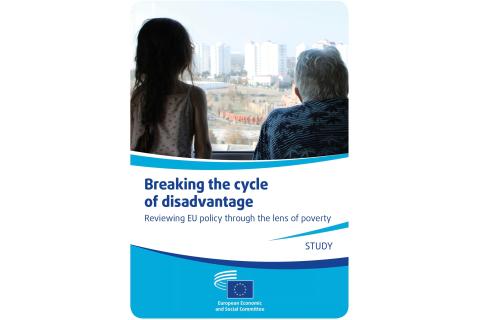
A new study by the European Economic and Social Committee (EESC) highlights the intergenerational aspect of poverty and presents an evidence-based definition of this phenomenon based on ten key drivers. It examines how EU policy addresses these factors and identifies areas where further action is needed, particularly with regard to parental education levels and family stability.
The study on Breaking the cycle of disadvantage - Reviewing EU policy through the lens of poverty is being published ahead of the International Day for the Eradication of Poverty and in the context of the first-ever European Anti-Poverty Strategy, presented by the European Commission in May 2026.
Cillian Lohan, President of the Civil Society Organisations' Group, which requested the study, said: With this study, we draw attention to the deep-rooted factors that perpetuate poverty over one’s life course and across generations, something we call 'Intergenerational poverty'. The EU must strongly support Member States’ efforts to combat poverty and ensure that policies reach local communities. Civil society, drawing on its longstanding commitment and expertise, stands ready to contribute.
The EESC study identifies ten key drivers of intergenerational poverty and analyses how 32 selected EU policy instruments address them and could be improved. It highlights the importance of examining parental education levels and family stability and proposes an evidence-based definition of intergenerational poverty.
The European Anti-Poverty Strategy emphasises that 'new investments and reforms need to (be) poverty-proof'. The EESC study provides a novel research framework that could help the European institutions assess the potential impact of future policies on intergenerational poverty from the earliest stages of policy design. It also offers valuable insights for shaping the EU's next long-term budget (2028-2034), which is currently still under negotiation.
The EESC's Civil Society Organisations' Group and the EESC have long been active in addressing the issue of poverty and the EESC is preparing to sign a Memorandum of Understanding on the first-ever European Anti-Poverty Strategy between its President, Séamus Boland, and European Commission Vice-President, Roxana Mînzatu. This study reflects and complements the EESC's commitment to work towards eradicating poverty. The EESC will shortly deliver its views on the proposals for an Anti-Poverty Strategy, on strengthening the EU Child Guarantee, and on the role of civil society in Europe’s fight against poverty.
The Group remains committed to the fight against poverty by advocating policies that support and empower communities, in line with the Agenda for Sustainable Development, which lies at the heart of its work programme for the 2025-2028 term.
Background:
Forthcoming highlights of the EESC's activities on eradicating poverty in 2026 include:
- High-level debate: The EESC will hold a debate on Eradicating Poverty by 2050: fulfilling our collective responsibility at its October plenary session on 22 October 2026 at 10.00 (CEST). EESC President, Séamus Boland, and European Commission Vice-President, Roxana Mînzatu, will sign a Memorandum of Understanding on the European Anti-Poverty Strategy.
- 16th EESC Civil Society Prize: The prize will reward excellence in civil society initiatives on Combating poverty in the EU. The deadline for applications is 6 November 2026 at 10.00 (CET).
- Expected presentation of and vote on related EESC opinions at the October plenary session on 21-22 October 2026:
- Shrinking democratic space as a barrier to achieving the Sustainable Development Goals in the European Union – placing civil society at the heart of Europe’s fight against poverty (SDG1) (Own-initiative opinion SOC/865)
- Strengthening the child guarantee (Opinion SOC/872)
- Anti-poverty strategy and inter-generational poverty (Exploratory opinion at the request of the Irish Presidency of the EU SOC/875)
Further information on the study can be found in an interview with the authors or on our dedicated website, which also includes an executive summary.
Work organisation
Related content


Downloads
-
PR: EESC study provides tools to improve EU measures against intergenerational poverty
Recommended for you
Tetyana Ogarkova: "The day of victory will come but it will not bring normality back"
Agenda
On 24 February 2022, the lives of millions of Ukrainians were turned upside down. Now, when we say the word "victory", we expect that day to be the way things used to be. A normal day, a day of peace…
Lutte contre la précarité énergétique: garantir un approvisionnement énergétique abordable devrait figurer au premier rang des priorités politiques des pays de l’UE
News
Alors que le nombre de ménages qui sont dans l’incapacité de chauffer leur logement va vraisemblablement augmenter dans l’Union, avec une inflation annuelle de l’énergie qui dépasse 40 %, il y a…
Les zones rurales ont le potentiel pour produire davantage de résultats
News
Si l’attrait de la vie à la campagne s’est accru ces toutes dernières années, de nombreuses zones rurales de l’Union restent confrontées à un certain nombre de problèmes qui dissuadent les personnes…
Pour lutter contre le sans-abrisme, il faut une approche globale et une action collective
News
Le 7 octobre dernier, le Comité économique et social européen (CESE) a tenu une conférence sur le sans-abrisme et les moyens d’éradiquer ce phénomène d’ici à 2030, en appliquant le principe du…
Un rôle actif pour la société civile organisée est essentiel à la résilience de l’Union européenne
News
Le CESE a tenu un débat en session plénière sur l’importance croissante de la société civile organisée et des villes pour mettre l’Europe en capacité de faire face aux chocs asymétriques et aux…