
European Economic
and Social Committee
The EU needs to establish a clear vision for the future of its energy system
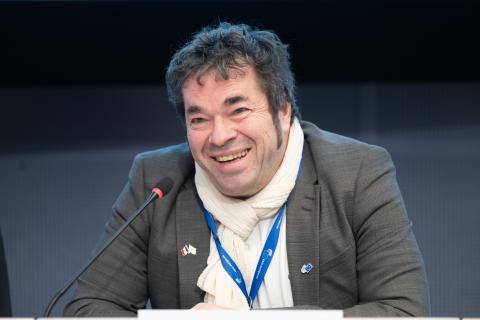
An opinion adopted at the EESC’s February plenary session points out that the European Union will only be able to secure a stable, low-carbon and affordable energy supply by adopting a comprehensive forward-looking approach that prioritises the security of the electricity system.
A secure and competitive electricity supply is the vital foundation that the EU needs to put in place as it seeks to protect its citizens and successfully revitalise its industry.
That is the strong conviction underpinning the opinion drawn up by Christophe Béguinet on Energy connectivity, electricity grids, which was adopted at the February plenary session of the European Economic and Social Committee (EESC).
In the opinion, the Committee assesses the future of the EU’s energy system and more specifically its electricity infrastructure. It also identifies steps that need to be taken to make the energy system more solidarity-based and efficient, for the benefit of all consumers, whether individuals or businesses.
‘Our energy system is a true cornerstone of European integration and securing its future demands an immediate common European response,’ said Mr Béguinet. ‘Our ambition and our mission are clear: we want to guarantee consumers access to quality, low-carbon, and above all, affordable electricity.’
To achieve these results, the Committee has put forward a number of recommendations, structured around three main pillars: a forward-looking mindset, a comprehensive approach and bolstering the security of the electricity grid.
Adopt a forward-looking vision
The EU must no longer operate without a clear vision. It must develop robust scenarios to guide the development of its energy system over the long term.
The European electricity sector must have the capacity to plan the needs of the electricity system at EU level and in partner countries, based on a common energy scenario set out by the Commission and national system operators.
Embrace a systemic approach
The Committee argues that it is vital to move beyond siloed thinking and adopt a comprehensive vision of the electricity system, encompassing generation, transmission and distribution.
This means that the European Commission must actively support interconnections, whether they serve bilateral interests or the overall resilience and efficiency of the system as a whole. Interconnections can only be effective if they are accompanied by development of the relevant national infrastructures, especially at transmission system operator (TSO) and distribution system operator (DSO) levels.
The creation of interconnection capacity must be seen as an opportunity to foster European solidarity regarding electricity networks. The economic model for interconnections will need to evolve accordingly to ensure cost-benefit sharing.
Build stronger electricity grid security
Finally, the EESC emphasises the need to secure the EU’s infrastructure, faced with the challenges that lie ahead, such as the increasing complexity involved in managing the grid, cyber threats, and the impact of climate change on power plants and networks.
The security of the electricity system must be a priority. To assess the extent of potential risks, the EESC recommends carrying out stress tests to check its resilience.
In addition, before considering developing new infrastructure, existing infrastructure should be optimised. In this regard, it would be useful if the key EU funding instrument for energy – the Connecting Europe Facility – were to cover grid-enhancing technologies as projects of common interest (PCIs), which would seek to increase the capacity of existing electricity interconnectors.
Background
This exploratory opinion was requested by the Cyprus Presidency of the Council of the European Union to reassess the EU’s ambitions for developing cross-border energy connectivity, and in particular electricity interconnections.
Increasing energy interconnectivity is essential to achieving: 1) energy security; 2) lower energy prices; and 3) the EU’s decarbonisation targets. Energy interconnectivity is also important in the framework of the New Pact for the Mediterranean and the India-Middle East-Europe Economic Corridor (IMEC), which is designed to connect the EU and the Middle East.
Energy remains a major concern for the EU from the point of view of the security of supply. The war in Ukraine and the recent blackouts in Spain, Portugal and the South of France have highlighted its strategic importance. The way ahead needs to involve a twofold approach: building a more integrated and resilient European energy system, and increasing cooperation with neighbouring regions.
The EU is also under pressure to guarantee access to competitive energy and to strengthen the industrial capacity of its Member States.
Work organisation
Recommended for you
YEYS! 2023: Jongeren vragen een EU die transparanter, digitaler en eenvoudiger is
News
Op 23 en 24 maart is bij het Europees Economisch en Sociaal Comité (EESC) de veertiende editie van Jouw Europa, jouw mening! (YEYS!) gehouden. Voor dat evenement kwamen 105 leerlingen van 35 scholen…
De elektriciteitsmarkt van de EU moet worden hervormd
News
Uit een door het Europees Economisch en Sociaal Comité (EESC) georganiseerd debat kwam naar voren dat het van cruciaal belang is de Europese elektriciteitsmarkt aan te passen om de zwakke punten…
Kandidaten kunnen zich nu aanmelden voor de EESC-prijs voor het maatschappelijk middenveld, die dit jaar geestelijke gezondheid als thema heeft
News
Maatschappelijke organisaties, individuen en particuliere ondernemingen kunnen nu met hun non-profitprojecten meedingen naar de EESC-prijs voor het maatschappelijk middenveld, die deze keer in het…
EESC roept de EU-burgers op om in juni 2024 te stemmen voor een verenigd en democratisch Europa
News
Tegen de achtergrond van een wereldwijde achteruitgang van de democratie, welig tierende desinformatie, groeiende ontevredenheid, stijgende inflatie en oorlogsdreiging, staat er veel op het spel bij…
De sociale en burgerdialoog kunnen de EU helpen duurzaam te groeien
News
Slechts enkele dagen na de Europese verkiezingen van 2024 kwamen het Europees Economisch en Sociaal Comité (EESC) en de nationale sociaal-economische raden van de EU bijeen om de stand van zaken van…