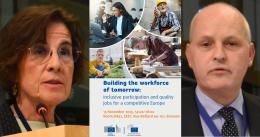
The EESC hosted a high-level conference on 13 November 2025, entitled “Building the workforce of tomorrow: inclusive participation and quality jobs for a competitive Europe.” The event brought together EU policymakers, social partners, researchers, and civil society to discuss the urgent challenges and opportunities facing Europe’s labour market, with a focus on two flagship reports.
urges the European Commission to adopt comprehensive action plans on all forms of disability, similar to those for youth and gender equality;
recommends closer cooperation with disabled people’s organisations (DPOs) in both international cooperation and EU humanitarian work, to enhance the effectiveness of disability diplomacy;
suggests that every diplomatic delegation involved in disability-related agreements should include at least one DPO representative at UN meetings. The aim is to formally designate disability focal points in each diplomatic delegation.
The EESC Section for Employment, Social Affairs and Citizenship (SOC) organised a hearing on "Accessible and Affordable Housing for All: Ensuring Inclusion of Persons with Disabilities in the EU". It brought together voices from the EU institutions, civil society, disability organisations and housing experts to address the urgent challenge of affordable and accessible housing across Europe.
At its June 2025 plenary session, the European Economic and Social Committee (EESC) adopted a forward-looking opinion on the future of the EU Strategy on the Rights of Persons with Disabilities, calling for a more ambitious and binding approach for the 2025–2030 period.
believes it is crucial to include persons with disabilities throughout the process of designing, developing, assessing and implementing new technologies and AI-based applications. This involvement is key to mitigating potential discriminatory risks;
invites the Member States and the EU to audit and evaluate to what extent AI applications are inclusive in critical fields;
believes further follow-up is required to protect persons with disabilities from the harmful application of supposedly limited risk systems, particularly in the field of employment and recruitment;
underlines the importance of ensuring the general accessibility of services and goods that apply new technologies and AI based solutions
The European Economic and Social Committee (EESC) held a debate to celebrate both the International Day of Persons with Disabilities and Olympic spirit during its plenary session on 5 December in Brussels.
The European Economic and Social Committee (EESC), has adopted an opinion supporting the inclusion of persons with disabilities in the open labour market, calling for the promotion of measures and policies (including the setup of a joint fund between Member States) that would buttress these efforts.
regrets that exclusion from the labour market is still a widespread issue, especially affecting women with disabilities and people with the most severe disabilities and believes that solutions such as sheltered employment often end up perpetrating segregation;
urges Member States to promote policies and measures that strengthen access to the open labour market and the Commission to implement the related policy actions under the Disability Employment Package;
calls on the Member States to step up the employment of persons with disabilities, for example through a joint fund for reasonable accommodation. Such fund would be financed by private and public employers who fall short of any set quotas.
Only nine EU countries criminalise forced sterilisation as a distinct offence, while 13 allow it to be performed on persons with disabilities – and in three of those countries that includes minors. When it comes to the sexual and reproductive health rights of women with disabilities, the EU is far from being a union of equality, an EESC hearing revealed
The EESC is calling for the scope of the Commission proposal for a European Disability Card to be expanded to cover longer stays for work and study, with the goal of fully achieving freedom of movement of persons with disabilities in the EU