Europa

This page is also available in:

EGSO u Europi održava odnose sa socijalnim partnerima i organizacijama civilnog društva na zapadnom Balkanu, u istočnom susjedstvu, u državama EFTA-e koje su članice EGP-a, odnosno u Islandu, Lihtenštajnu i Norveškoj, te u Ujedinjenoj Kraljevini.

Odbor za praćenje zapadnog Balkana – trajno unutarnje tijelo EGSO-a – glavni je instrument za koordinaciju aktivnosti EGSO-a u toj regiji. Forum civilnog društva zapadnog Balkana, koji se održava svake dvije godine, spada u rad tog Odbora za praćenje.

EGSO također bilateralno surađuje sa zemljama zapadnog Balkana koje su započele pregovore o pristupanju i s Turskom putem specijaliziranih tijela osnovanih na temelju sporazuma o pridruživanju između tih zemalja i EU-a. Svrha je tih zajedničkih savjetodavnih odbora uključiti socijalne partnere i organizacije civilnog društva u praćenje pretpristupnog procesa i procesa reformi koji bi mogli dovesti do članstva u EU-u. Svako od tih tijela sastoji se od jednakog broja članova iz EGSO-a i partnerske zemlje i obično se sastaje jednom ili dvaput godišnje.

EGSO je također osnovao Odbor za praćenje istočnog susjedstva, unutarnje tijelo nadležno za jačanje odnosa s civilnim društvom u zemljama te regije, odnosno Armeniji, Azerbajdžanu, Bjelorusiji, Gruziji, Moldaviji i Ukrajini.

Glavni mehanizmi suradnje s Armenijom, Gruzijom, Moldavijom i Ukrajinom su platforme civilnog društva koje organizacijama civilnog društva iz EU-a i partnerskih zemalja omogućuju praćenje provedbe sporazuma EU-a s tim zemljama i izradu preporuka za nadležna tijela. Povrh toga, Ukrajina i Moldavija postale su zemlje kandidatkinje 2022.

Kad je riječ o Bjelorusiji i Rusiji, razvijaju se odnosi s onim organizacijama civilnog društva koje još slobodno djeluju, od kojih je većina smještena na teritoriju EU-a. EGSO smatra da je važno održavati otvoren dijalog dok se čeka da u budućnosti zavladaju bolji uvjeti.

Europski gospodarski prostor (EGP) okuplja države članice EU-a i tri države EFTA-e (Island, Lihtenštajn i Norvešku) na unutarnjem tržištu na kojem se roba, usluge, kapital i osobe slobodno kreću. EGSO je član Savjetodavnog odbora za Europski gospodarski prostor, u kojem se s predstavnicima socijalnih partnera iz država EFTA-e koje su članice EGP-a raspravlja o pitanjima od zajedničkog interesa.

Naposljetku, u okviru EGSO-a djeluje i Odbor za praćenje EU-a i Ujedinjene Kraljevine čija je zadaća pratiti odnose između EU-a i Ujedinjene Kraljevine Velike Britanije i Sjeverne Irske iz perspektive civilnog društva. Taj se odbor prvenstveno bavi provedbom Sporazuma o povlačenju Ujedinjene Kraljevine iz EU-a i Protokola o Irskoj i Sjevernoj Irskoj, o kojima raspravlja s organizacijama civilnog društva iz Ujedinjene Kraljevine, kao i provedbom Sporazuma o trgovini i suradnji između EU-a i Ujedinjene Kraljevine, u vezi s kojim surađuje s Unutarnjom savjetodavnom skupinom EU-a uspostavljenom u okviru tog ugovora.
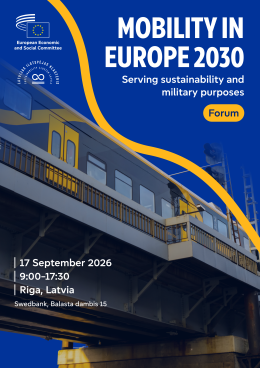

  • The TEN section, in cooperation with the Latvian Sustainability Cluster, is organising a forum on Mobility in Europe 2030 – serving sustainability and military purposes on 17 September 2026 in Riga, Latvia. The forum will deliver recommendations, identify investment and regulatory priorities, and clarify implementation pathways. The outcome of the forum will feed into the EESC’s policy work at EU level and provide practical guidance for Member States in advancing climate-neutral, resilient and competitive mobility systems, including strengthened military mobility, in response to evolving geopolitical challenges. 

  • On 25th of March, the EESC Workers’ Group gathered together with a number of guest speakers from academia, trade unions and MEPs from the European Parliament, to discuss the current geopolitical situation, its impact on social and defence expenditure, its spillovers on supply chains and industry, and the consequences for the welfare states and workers’ rights.  

  • Published in
    Study
    36 pages

    This study examines how social partners and civil society organisations in six Member States — Italy, Austria, Hungary, Poland, Portugal and Sweden — view the effectiveness of current policies in raising employment levels and increasing adult participation in training. It also puts forward recommendations for improving policy outcomes.

  • Published in
    28 pages

    On 8 June 2022 the Consultative Commission on Industrial Change (CCMI) celebrated its 20th anniversary with a conference focused on the challenges of today and the prospects for tomorrow. This publication is a record of the occasion and a commemoration of what CCMI has achieved since joining the EESC.

  • Published in
    Study
    63 pages

    Exploring the evolving landscape of generative artificial intelligence (GenAI) within the European Union, this study delves into technological advancements, market dynamics, and regulatory challenges. It highlights the EU’s position in the global GenAI ecosystem, revealing significant US dominance, while uncovering sector-specific opportunities and risks across industries such as automotive, renewable energy, and education.

  • Published in
    Study
    71 pages

    Taking Stock of SDG 2 and Future Perspectives

  • The EESC:

    • suggests that a systematic stocktaking exercise be carried out, evaluating how EU funds and instruments are perceived and used by the Arctic stakeholders in practice;
    • calls for Arctic decision-makers at all levels to more rigorously apply legal obligations and draw inspiration from best-practice standards and mechanisms for including, consulting and empowering all section of local civil society;
    • supports and encourages full consultation of and cooperation with indigenous peoples in the Arctic, bearing in mind the principle of free, prior and informed consent, before adopting and implementing measures that might affect them directly.
  • Where do EU-US relations go from here?

    In this issue:

    • Our members comment on the results of the US presidential election and reflect on their possible impact;
    • Guest articles by Lennart NILSSON (General Confederation of Agricultural Cooperatives - COGECA), Beatriz ABELLÁN MERELO (Foundation for European Progressive Studies - FEPS) and Francesca CARLSSON (European Environmental Bureau - EEB);
    • Report on our recent conference on protecting Europe's most vulnerable through sustainable and affordable housing;
    • Interview with rapporteur Anastasis YIAPANIS on the new EESC opinion on 'Advanced materials for industrial leadership'.
    • Civil Society Organisations' Bulletin - December 2024
  • Reference number
    39/2024

    The European elections proved that the pro-European majority still holds, but also showed that voters across the EU demand urgent political and legislative responses to the challenges raised in the electoral campaign. Otherwise, the pro-European majority may risk losing support as citizens may increasingly turn their backs on the mainstream political forces.

  • Published in
    15 pages

    This document seeks to provide input to the Global Coalition for Social Justice. It highlights key messages from EESC opinions on the six priority areas identified by the International Labour Organization (ILO) for immediate action.