The conference "The Anti-Money Laundering Legislative Package" will take stock of the state of play and debate in particular the legislative proposals tabled by the European Commission in July 2021 to strengthen the EU's anti-money laundering and countering terrorism financing (AML/CFT) rules.
The conference is organised on 5 October 2021, starting at 14:30.
The event is accessible via webstream. No registration is needed, and participation is free of charge.
The EESC considers that it is necessary to add new own resources to cover the debt repayment resulting from borrowing under the NextGenerationEU initiative without jeopardising the budgets of other EU programmes and instruments, or substantially increasing the Gross National Income (GNI)-based resource contribution. Although the Commission proposals as set out in the communication are deemed necessary, EESC believes that the Commission should ensure that the design of the new system is based on achieving equity and fairness, efficiency, transparency, simplicity and stability, with a focus on competitiveness and applying solidarity where necessary.
Download format:
Download — EMSK arvamus: Proposal for an own resources decision
The EESC strongly supports the goal of redirecting investments in such a way that they contribute to the EU's transition to a sustainable economy but calls for the social partners and civil society to be brought better on board in the design and implementation of sustainable finance. The EU green bond standard has the potential to yield significant economic benefits for both issuers and investors alike and help the green transition.
The EESC strongly supports the goal of redirecting investments in such a way that they contribute to the EU's transition to a sustainable economy but calls for the social partners and civil society to be brought better on board in the design and implementation of sustainable finance. The EU green bond standard has the potential to yield significant economic benefits for both issuers and investors alike and help the green transition.
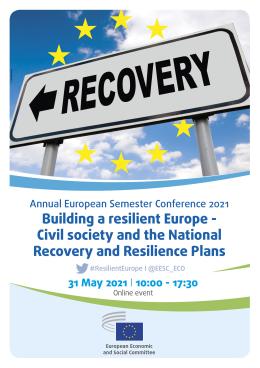
Building a resilient Europe - Civil society and the National Recovery and Resilience Plans
Event type
Conference
Location
Brussels
Belgium
The Recovery and Resilience Facility is moving into its next phase, and the European Semester Group of the EESC is following the process. In this high-level conference we will discuss whether the national recovery and resilience plans will deliver as regards the aim of achieving fair, inclusive, competitive and sustainable growth and cohesion through the new growth strategy – the European Green Deal. Focus will be on the implementation of the national recovery and resilience plans, with particular attention on the implementation of the European Pillar of Social Rights and the just transition towards a green, digital and sustainable European economy. The conclusions of this event will be forwarded to EU institutions and the "EU Recovery Summit" conference in Lisbon on 28 June 2021.
The EESC laments the severity of the money laundering phenomenon in the EU. Current European legislation is largely inadequate in the face of coordination failures and national divergences, and therefore strongly supports the Anti Money Laundering legislative package, in particular the creation and design of the new European Anti-Money Laundering Authority (AMLA) with direct supervisory powers.