Recovery from the current crisis, the impasse on long term EU budget and the future of the EU were the main topics of the discussion between the president of the EESC, ChristaSchweng, and the president of the European Parliament, David Sassoli. The two presidents met virtually on 1 December for the first time in the current EESC term.
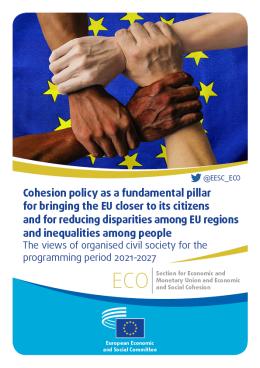
This brochure presents the EESC's opinions relating to the cohesion policy for the post-2020 period. It demonstrates the important role played by organised civil society representatives during this period in exerting influence on decision-makers, which led to the adoption of a number of important policy packages concerning the next programming period. The EESC was the first European institution to contribute to the development of the new programming period (2021-2027).
This brochure presents the EESC's opinions, position papers, resolutions and statements calling for the necessary measures to be taken at EU level, or commenting on those that have already been put forward, in order to tackle the economic effects of the COVID-19 pandemic. We pushed for a reconstruction and recovery plan that lives up to this unprecedented challenge.
In this brochure, we have put together a series of semester-related opinions and an information report in which the EESC makes policy recommendations on the various elements of the European Semester.
This study focuses on the use of trilogues and early agreements in the European Union (EU). Today, trilogues form the standard operating procedure for reaching agreements between the European Commission, European Parliament, and the Council of the EU. The use of trilogues has long raised concerns about public transparency and accountability. Much has already been done to improve the way in which each institution’s negotiating team is held accountable to their respective institutions. However, there is still scope for improving the transparency of trilogue meetings.
After the European elections, what agenda for the EU?
In this issue:
Our members share their expectations and proposals for the EU agenda 2024-2029
Guest articles by László Bercse (Vice-President, Inclusion Europe), Rareș Voicu (President, European Youth Forum) and Radu Caragea-Szucs (Vice-President, Funky Citizens)
Special interview with EESC Vice-President Aurel Laurenţiu Plosceanu on the European elections
Report on our recent conference on 'The State of Health in the EU'
Interview with rapporteur Stoyan Tchoukanov on the EESC opinion 'Promoting autonomous and sustainable food production: strategies for the Common Agricultural Policy post-2027'
EU elections 2024: a critical moment to rewrite Europe's future
In this issue:
Our members discuss the 2024 elections to the European Parliament
Guest articles by Antonella Valmorbida (Secretary-General of the European Association for Local Democracy and Board Member of the European Partnerships for Democracy) and Diana Dovgan (Secretary-General of the European Confederation of Industrial and Service Cooperatives)
Interview on gender and diversity among MEPs in view of the 2024 elections
Interview on the EESC study 'The cost of climate change on households and families in the EU'
Reports on recent events
Civil Society Organisations' Bulletin - December 2023