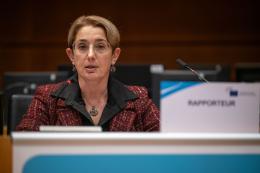
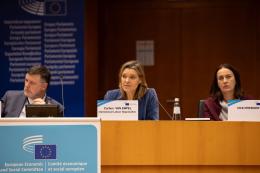
In an opinion that was adopted at its December plenary, the European Economic and Social Committee (EESC) urges the European Commission to radically strengthen the Union Civil Protection Mechanism (UCPM), calling for a strategic pivot away from last-minute emergency response and toward comprehensive disaster prevention. The warning comes as Europe faces increasingly volatile climate extremes, cyber-physical threats, and geopolitical instability.
At its December 2025 plenary session, the European Economic and Social Committee (EESC) adopted an opinion supporting the European Commission’s proposals for the AgoraEU and Justice programmes for 2028–2034. The EESC calls for robust support for civil society, enhanced democratic participation, and a stronger European Area of Justice, in the pursuit of a free and democratic Europe.
In an opinion that was adopted at its December plenary, the European Economic and Social Committee (EESC) urges the EU to step up public and private investment in space, with the end goal of reinforcing strategic autonomy and promoting innovation. The Committee also advises increasing the funds allocated to the European Union Agency for the Space Programme (EUSPA) in the next Multiannual Financial Framework (covering 2028–2034).
The European Economic and Social Committee (EESC) has endorsed the European Commission’s new strategy to overhaul the single market, while calling for fully-fledged implementation of single market-related measures and effective enforcement of EU legislation.
The long-anticipated EU strategic approach to the Black Sea, which recognises the region as a critical hub for security, stability, and economic prosperity, arrives late and with limited ambition, underscores the European Economic and Social Committee (EESC), while calling for it to be swiftly implemented and properly resourced.
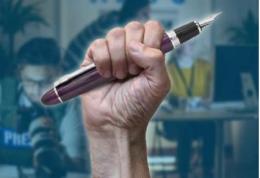
At its December 2025 plenary session, the European Economic and Social Committee (EESC) adopted an own-initiative opinion calling for urgent action to strengthen labour rights for journalists and media professionals across Europe. The EESC’s message is clear: decent working conditions are essential to safeguard the independence of journalism and ensure citizens’ access to reliable, pluralist, and truthful information.
At its December plenary, the European Economic and Social Committee (EESC) held a debate on “Thirty COPs later and a decade after the Paris Agreement: assessing global climate action and opportunities for civil society”, with reactions to the outcome of COP30 at the center of discussion. The conference in Belém closed with a now-familiar warning: the world remains far from the ambition needed to keep global warming within 1.5°C.
The cooperative model has proved its ability to establish competitive companies rooted in inclusivity and worker participation. As the EESC’s opinion stresses, it is becoming increasingly important to maintain industrial capacity within the EU, in the interests of its security and strategic autonomy.
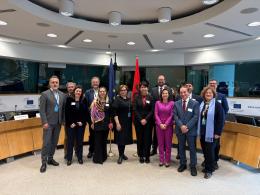
Albania remains firmly committed to EU integration, advancing accession negotiations and implementing the growth plan for the Western Balkans, with reforms in the rule of law, digitalisation and the green transition. However, anti-corruption and media freedom require further robust efforts. These topics were at the centre of discussions during the 2nd meeting of the EU-Albania Civil Society Joint Consultative Committee on 21 November 2025.