
European Economic
and Social Committee
Albania demonstrates its political commitment to the EU accession path, however, reforms still need to be delivered
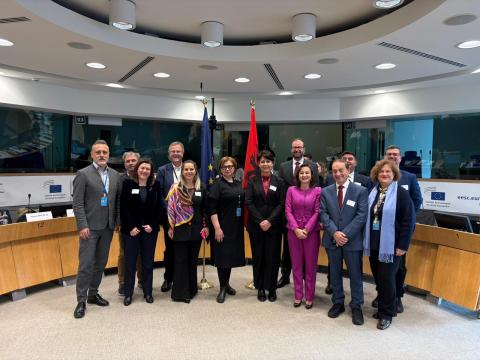
Albania remains firmly committed to EU integration, advancing accession negotiations and implementing the growth plan for the Western Balkans, with reforms in the rule of law, digitalisation and the green transition. However, anti-corruption and media freedom require further robust efforts. These topics were at the centre of discussions during the 2nd meeting of the EU-Albania Civil Society Joint Consultative Committee on 21 November 2025.
Following the Commission’s adoption of the 2025 enlargement package and the release of Albania’s 2025 report on 4 November 2025, the members of the EU-Albania Joint Consultative Committee (JCC) gathered at the European Economic and Social Committee (EESC) to discuss the state of play of Albania’s accession process. Both sides acknowledged that civil society plays a crucial role in anchoring Albania’s EU accession reforms in democratic legitimacy and public accountability.
"We are here today to make sure that accession negotiations with the European Union, and the implementation of all the important reforms and regulations that are linked with this process, fully take into account the views of the organised civil society in the country, meaning employers associations, trade unions and civil society organisations.", underscored Violeta Jelić, the co-chair of the JCC from the EU side and the President of the Western Balkans Follow-up Committee. The participants underscored that enlargement must go beyond bureaucratic technicalities: ‘Enlargement is not a technical process but a political and societal transformation,’ said Ionuț Sibian, EESC member and vice-president of the EESC’s External Relations (REX) section Andrej Zorko, vice-president of the REX Western Balkans Follow-up Committee, added that ‘civil society must be included in every stage of the reforms. They know best what people living there need’.
Their calls reflect concerns raised in the 2025 Rule of Law Report, which highlight that weak public consultations and a lack of stakeholder input in the legislative process continue to undermine inclusive governance.
Participants highlighted civil society’s demand for genuine transparency and not simply formal consultation procedures, and stressed that reforms must deliver ‘tangible results in daily life,’ from labour rights and youth participation to media freedom and protection of civic space.
Co-chair of the JCC from the Albanian side, Juliana Hoxha summarised this imperative clearly: ‘citizens need to feel that the process belongs to them and that their voices are heard’.
Hubert Duhot from the Commission’s Directorate-General for Neighbourhood and Enlargement Negotiations (DG ENEST) reiterated that accession is strictly merit-based, emphasising that ‘there is no shortcut to the EU – the process requires real delivery on the ground’.
Despite strong political commitment and demonstrable progress, the 2025 enlargement package, the Commission’s Rule of Law Report and the JCC discussions all underline that major institutional reforms remain unfinished. Albania has completed the first-instance vetting of all judges and prosecutors, however, deep structural staffing gaps persist.
In the field of anti-corruption, Albania has already adopted the 2024-2030 strategy, and its special anti-corruption body, known as SPAK, has made ‘tangible progress toward a solid track record’. However, prevention mechanisms remain weak, coordination with law enforcement is limited, and corruption risks spilling over across several sectors.
Media freedom remains one of the least-advanced areas, with high ownership concentration, pressure on journalists and weak regulatory independence undermining pluralism. The Commission stresses that no accession chapter can be provisionally closed until interim benchmarks on the rule of law, judicial independence, organised crime and fundamental rights are fully met, making clear that Albania’s rapid opening of negotiation clusters must now be matched by deep, sustained implementation to reach its 2027-2030 reform targets.
At the end of the meeting a joint declaration was adopted, which will be shared with the EU institutions, governments and social partners.