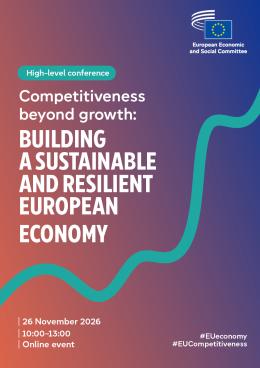
As Europe seeks to strengthen its competitiveness in an increasingly fragmented global economy, the challenge is not only to boost productivity and innovation, but also to preserve the foundations of its social market economy. This high-level conference will examine how the EU can mobilise savings and investment, maintain sustainable public finances, and deepen Economic and Monetary Union to support long-term growth, resilience and convergence.
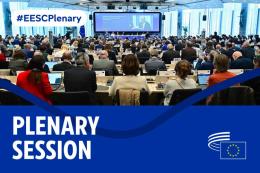
The agenda and all information regarding this plenary session will be available 8 days prior to the event. You will be able to follow the debates by web streaming. Web streaming
On Tuesday 1 December, from 14:30-16:30 CEST, the EESC's Permanent Group on Sustainable Food Systems is hosting a debate on how to unlock the potential of the plant-based sector.
On Tuesday 1 December, from 10:00-13:00 CEST, the EESC's Permanent Group on Sustainable Food Systems is hosting a debate on the upcoming revision of the Unfair Trading Practices (UTPs) Directive.
Europe has made major progress in building its battery value chain, but global competition, especially from Asia, is intensifying. How can Europe keep its place on the global battery map? The European Economic and Social Committee's Consultative Commission on Industrial Change (CCMI) and the Batteries European Partnership Association (BEPA) invite you to a morning of keynotes and debates.
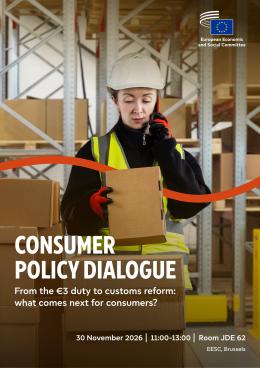
From the €3 duty to customs reform: what comes next for consumers?
Location
Brussels
Belgium
Following the introduction of the temporary €3 customs duty on low-value parcels on 1 July 2026, the European Economic and Social Committee (EESC) will organise a Consumer Policy Dialogue on 30 November 2026 to bring together EU institutions, consumer organisations, businesses and customs authorities to assess the initial impacts of the measure and discuss its implications for consumers and businesses in the context of the wider EU Customs Reform.
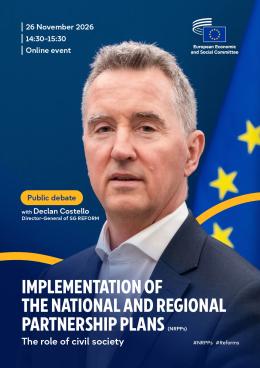
The ECO Section will hold a policy debate with Declan Costello, Director-General of SG REFORM, on the implementation of the National and Regional Partnership Plans (NRPPs) under the next EU Multiannual Financial Framework (2028–2034). The discussion will focus on the role of organised civil society in the design, implementation and monitoring of the NRPPs, with particular emphasis on safeguarding the partnership principle and multilevel governance.
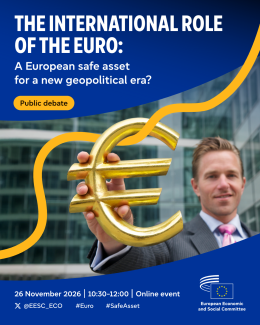
Public debate in the ECO Section on the "The international role of the euro: A European safe asset for a new geopolitical era?". This public debate will explore the opportunities and challenges associated with strengthening the international role of the euro and discuss the economic, financial and geopolitical arguments for and against the creation of a European safe asset.