rue Belliard 101, Jacques Delors building, room JDE 63, 9:30-11:00
Brussels
Belgium
EESC, room JDE 63, 9:30-11:00
The policy debate brings together stakeholders to assess how National and Regional and Partnership Plans will work in practice. In a workshop setting connected to the European Economic and Social Committee, participants from civil society, social partners and institutions will exchange perspectives on transparency, inclusiveness and impact. The discussion aims to highlight gaps, share best practices and strengthen the role of organised civil society in shaping and monitoring the implementation of NRPPs in the EU.
The European Public Diplomacy Days – EPDD – will be held from 30 September to 2 October 2026 and will bring together various different European Union (EU) institutions working on public diplomacy and international people-to-people initiatives. The idea is to share best practice and exchanging ideas.
Besides the EU institutions, there will be contributions from civil society, networks of regions and cities, cultural projects, academics and other practitioners from across the world.
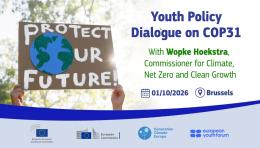
The European Commission and the European Economic and Social Committee, in cooperation with the European Youth Forum and Generation Climate Europe, will organise the Youth Policy Dialogue on COP31. The event will take place on Thursday 1 October 2026.
The Consultative Commission on Industrial Change (CCMI) of the European Economic and Social Committee will convene an expert hearing to advance policy discussions on fostering innovation and digitalisation in the construction sector.
Preparedness in the EU: The role of the liberal professions
Location
Van Maerlant street 2, Room VMA 22
Brussels
Belgium
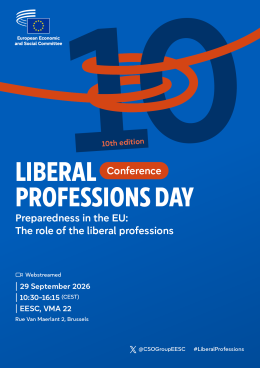
Join us on 29 September 2026 from 10:30 to 16:15 CEST in Brussels, when the Liberal Professions Category of the EESC will proudly present the 10th edition of the Liberal Professions Day with the theme 'Preparedness in the EU: the role of the liberal professions'. The conference is open to the public. For in-person participation, please register by 24 September 2026 via our registration form.
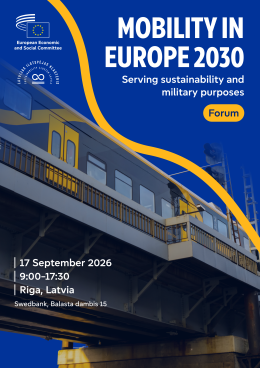
The TEN section, in cooperation with the Latvian Sustainability Cluster, is organising a forum on Mobility in Europe 2030 – serving sustainability and military purposes on 17 September 2026 in Riga, Latvia. The forum will deliver recommendations, identify investment and regulatory priorities, and clarify implementation pathways. The outcome of the forum will feed into the EESC’s policy work at EU level and provide practical guidance for Member States in advancing climate-neutral, resilient and competitive mobility systems, including strengthened military mobility, in response to evolving geopolitical challenges.
This public hearing will aim to examine the growing threat of gender-based cyberviolence against women and girls, including deepfake pornography, non-consensual image sharing and 'nudification' apps. Such abuses are used to intimidate, silence and discredit women in public and professional life. The hearing will explore how to hold perpetrators accountable and identify effective measures to combat online misogyny and protect women’s rights online.
Bulgarian Chamber of Commerce and Industry (9 Iskar Str, Sofia, Bulgaria), and remotely via online platform
Sofia
Bulgaria
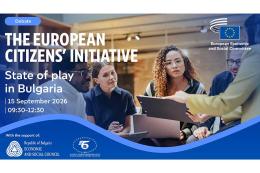
On 15 September 2026, the EESC Group on the European Citizens’ Initiative, with the support of the Economic and Social Council of the Republic of Bulgaria and the Bulgarian Chamber of Commerce and Industry, will organise a debate in Sofia on the state of play of the European Citizens’ Initiative in Bulgaria.
The event will bring together ECI stakeholders and communicators, such as representatives of EU institutions, civil society, youth, academia and local authorities, to discuss how awareness, visibility and participation in the European Citizens’ Initiative can be further strengthened at national level.
Participants will exchange experiences, good practices and ideas on how to make this unique EU participatory democracy tool more accessible and impactful for Bulgarian citizens.
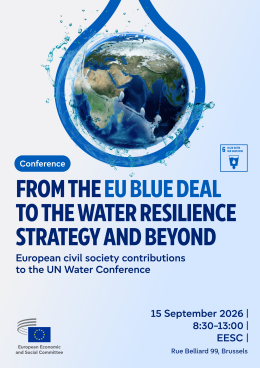
Save the date! On 15 September, the CCMI will organise a high-level event bringing together European civil society and key stakeholders to help shape the EU’s contribution to the UN Water Conference 2026. Building on the EESC’s work on the EU Blue Deal and its recently adopted opinion on this process, the event will foster dialogue and deliver key recommendations from civil society to EU and global decision-makers, feeding into global water policy discussions.