
European Economic
and Social Committee
AI as Europe’s Strategic Edge: Employers call for action to empower SMEs
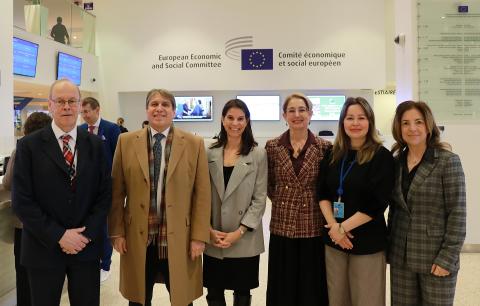
Artificial intelligence (AI) is no longer a vision of the future, it is already reshaping how European businesses operate and compete. Opening the Employers’ Group’s annual exchange with the leaders of Europe’s main business organisations, President Sandra Parthie highlighted the scale and urgency of the challenge: “AI is already transforming enterprises today, from resilient supply chains that withstand global disruptions to personalised services that build customer loyalty. The impact is real and measurable.”
Across Europe, 44% of companies report productivity gains from AI, with average savings or profits exceeding €6 million per business. One in three workers already uses AI tools to streamline daily tasks, contributing up to 1.3 percentage points in additional annual productivity growth. Yet the reality remains uneven: large firms lead in adoption, while many smaller ones struggle to seize the opportunity.
“In a world defined by geopolitical turbulence, from Russia’s war of aggression against Ukraine to the global AI race between the US and China, Europe must see AI as more than a tool,” Parthie underlined. “It is our strategic edge.” To harness it fully, she called for “concrete, rapid and scalable actions” to enable SMEs and scale-ups to bring AI solutions to market. That means easier access to finance, simpler administrative processes, clearer IP rules and stronger cross-border collaboration within the Single Market.
The debate featured Véronique Willems, Secretary General of SMEunited, Valeria Ronzitti, Secretary General of SGI Europe, and Markus J. Beyrer, Director General of BusinessEurope — all agreeing that AI’s success depends on European cooperation and proportionate regulation.
Willems warned of a significant shortage of AI skills in Europe, limiting SMEs’ ability to innovate. “SMEs are currently moving at three speeds: those developing AI, those using AI tools, and those still finding their way around AI,” she observed. Developers face barriers to data and computing access, while users need legal certainty on data use and GDPR compliance. For newcomers, capacity building and AI literacy are the first steps. She urged policymakers to keep the “Think Small First” principle at the heart of regulation: “Reporting and compliance obligations must remain strictly proportionate so entrepreneurs can focus on growth, not bureaucracy.”
Ronzitti showcased AI’s tangible benefits in public services — from energy and transport efficiency to water management — but warned that regulatory complexity and public mistrust still hold back progress. “We need smarter, not heavier, regulation and renewed social dialogue around these technologies,” she insisted.
Beyrer placed AI in the context of Europe’s competitiveness challenge. “We need AI to sustain our productivity and prosperity compared to other global blocs,” he said. He cautioned that fragmented or over‑restrictive regulation could slow digital transformation, urging consistency across Member States. “Simplification and better implementation are crucial if Europe wants to move from ambition to delivery.”
Parthie also called for the next Multiannual Financial Framework (2028–2034) to reflect Europe’s AI ambitions, with predictable, long-term funding for research, infrastructure and skills. “Dedicated instruments for SMEs, regional innovation clusters, and the transformation of digital innovation hubs into true AI experience centres will be essential,” she said. Strategic public procurement should also be used to reward innovation, security, and sustainability, while remaining transparent and technology-neutral.
Closing the discussion, Parthie invited all partners to build on their shared agenda. “Just as we brought competitiveness back to the EU policy debate, we can now ensure AI serves people and prosperity — not bureaucracy,” she concluded. “Together, let’s design a blueprint for European business to lead and thrive in the AI era.”
Work organisation
Recommended for you
Η εργαλειοποίηση των μεταναστών και η προσφυγική κρίση της Ουκρανίας επιβάλλουν ένα νέο ξεκίνημα για τη μεταναστευτική πολιτική
News
Η κρατική εργαλειοποίηση των μεταναστών, που αποσκοπεί στην αποσταθεροποίηση της ΕΕ, και ο τρέχων πόλεμος στην Ουκρανία, που οδηγεί σε πρωτόγνωρη εισροή προσφύγων, επιβάλλουν την επανεξέταση της…
YEYS! 2023: Οι νέοι ζητούν μια πιο διαφανή, ψηφιακή και απλοποιημένη ΕΕ
News
Στις 23 και 24 Μαρτίου, η Ευρωπαϊκή Οικονομική και Κοινωνική Επιτροπή (ΕΟΚΕ) φιλοξένησε την 14η διοργάνωση της εκδήλωσης «Η δική σου Ευρώπη, η δική σου φωνή!» (YEYS!), η οποία προσέλκυσε στις…
Η ΕΕ χρειάζεται αποτελεσματικότερη πολυμέρεια για την αντιμετώπιση των κινδύνων που σχετίζονται με την ασφάλεια στη θάλασσα, επισημαίνει η ΕΟΚΕ
News
Η Ευρωπαϊκή Οικονομική και Κοινωνική Επιτροπή (ΕΟΚΕ) ζητεί περισσότερες κοινές δράσεις σχετικά με τη στρατηγική της ΕΕ για την ασφάλεια στη θάλασσα και το σχετικό σχέδιο δράσης, που αποσκοπούν στη…
Η ΕΟΚΕ δρομολογεί τη διαδικασία υποβολής υποψηφιοτήτων για το Βραβείο της Κοινωνίας των Πολιτών, το οποίο θα αφορά την ψυχική υγεία
News
Οι οργανώσεις της κοινωνίας των πολιτών, οι ιδιώτες και οι ιδιωτικές εταιρείες μπορούν τώρα να υποβάλουν τα μη κερδοσκοπικά έργα τους για το βραβείο της ΕΟΚΕ που είναι αφιερωμένο στη στήριξη της…
#ReskillEU — Το εργατικό δυναμικό της Ευρώπης στους τομείς της ενέργειας και των μεταφορών χρειάζεται νέες δεξιότητες για να κάνει πραγματικότητα την απανθρακοποίηση
News
Για να επιτύχει η απανθρακοποίηση των τομέων της ενέργειας και των μεταφορών της ΕΕ, οι εν λόγω τομείς χρειάζονται εργαζομένους εξοπλισμένους με «νέες» δεξιότητες, προειδοποιεί η Ευρωπαϊκή Οικονομική…