
European Economic
and Social Committee
AI as Europe’s Strategic Edge: Employers call for action to empower SMEs
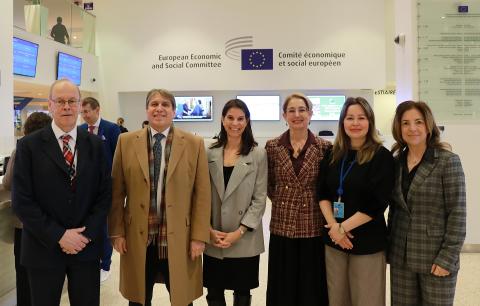
Artificial intelligence (AI) is no longer a vision of the future, it is already reshaping how European businesses operate and compete. Opening the Employers’ Group’s annual exchange with the leaders of Europe’s main business organisations, President Sandra Parthie highlighted the scale and urgency of the challenge: “AI is already transforming enterprises today, from resilient supply chains that withstand global disruptions to personalised services that build customer loyalty. The impact is real and measurable.”
Across Europe, 44% of companies report productivity gains from AI, with average savings or profits exceeding €6 million per business. One in three workers already uses AI tools to streamline daily tasks, contributing up to 1.3 percentage points in additional annual productivity growth. Yet the reality remains uneven: large firms lead in adoption, while many smaller ones struggle to seize the opportunity.
“In a world defined by geopolitical turbulence, from Russia’s war of aggression against Ukraine to the global AI race between the US and China, Europe must see AI as more than a tool,” Parthie underlined. “It is our strategic edge.” To harness it fully, she called for “concrete, rapid and scalable actions” to enable SMEs and scale-ups to bring AI solutions to market. That means easier access to finance, simpler administrative processes, clearer IP rules and stronger cross-border collaboration within the Single Market.
The debate featured Véronique Willems, Secretary General of SMEunited, Valeria Ronzitti, Secretary General of SGI Europe, and Markus J. Beyrer, Director General of BusinessEurope — all agreeing that AI’s success depends on European cooperation and proportionate regulation.
Willems warned of a significant shortage of AI skills in Europe, limiting SMEs’ ability to innovate. “SMEs are currently moving at three speeds: those developing AI, those using AI tools, and those still finding their way around AI,” she observed. Developers face barriers to data and computing access, while users need legal certainty on data use and GDPR compliance. For newcomers, capacity building and AI literacy are the first steps. She urged policymakers to keep the “Think Small First” principle at the heart of regulation: “Reporting and compliance obligations must remain strictly proportionate so entrepreneurs can focus on growth, not bureaucracy.”
Ronzitti showcased AI’s tangible benefits in public services — from energy and transport efficiency to water management — but warned that regulatory complexity and public mistrust still hold back progress. “We need smarter, not heavier, regulation and renewed social dialogue around these technologies,” she insisted.
Beyrer placed AI in the context of Europe’s competitiveness challenge. “We need AI to sustain our productivity and prosperity compared to other global blocs,” he said. He cautioned that fragmented or over‑restrictive regulation could slow digital transformation, urging consistency across Member States. “Simplification and better implementation are crucial if Europe wants to move from ambition to delivery.”
Parthie also called for the next Multiannual Financial Framework (2028–2034) to reflect Europe’s AI ambitions, with predictable, long-term funding for research, infrastructure and skills. “Dedicated instruments for SMEs, regional innovation clusters, and the transformation of digital innovation hubs into true AI experience centres will be essential,” she said. Strategic public procurement should also be used to reward innovation, security, and sustainability, while remaining transparent and technology-neutral.
Closing the discussion, Parthie invited all partners to build on their shared agenda. “Just as we brought competitiveness back to the EU policy debate, we can now ensure AI serves people and prosperity — not bureaucracy,” she concluded. “Together, let’s design a blueprint for European business to lead and thrive in the AI era.”
Work organisation
Recommended for you
Pro odolnost EU má zásadní význam aktivní úloha organizované občanské společnosti
News
Na plenárním zasedání EHSV se diskutovalo o tom, jak roste význam organizované občanské společnosti a měst, neboť ovlivňují schopnost Evropy čelit asymetrickým otřesům a neočekávaným…
Mladí lidé coby hybatelé změn a evropské integrace zemí západního Balkánu
News
V rámci konference občanské společnosti na vysoké úrovni na téma Politika v oblasti mládeže v zemích západního Balkánu, kterou uspořádal Evropský hospodářský a sociální výbor (EHSV),…
České předsednictví chce dát Evropě nové pojetí, novou podobu a nový impuls
News
Jedním z bodů červencového plenárního zasedání Evropského hospodářského a sociálního výboru (EHSV) byla diskuse s českým ministrem zahraničních věcí Janem Lipavským o…
Vaše Evropa, váš názor (YEYS!) 2023: Mladí lidé požadují transparentnější, digitálnější a zjednodušenou EU
News
Evropský hospodářský a sociální výbor (EHSV) uspořádal ve dnech 23. a 24. března 14. ročník akce Vaše Evropa, váš názor (YEYS!). V jejím rámci se v Bruselu sešlo 105 studentů z 35 škol ze všech 27…
Spravedlivý přechod na nízkouhlíkovou společnost není možný bez účasti občanské společnosti
News
Dolní Vítkovice v Ostravě jsou bývalou průmyslovou oblastí, kde se dříve těžilo uhlí a vyráběla ocel. 11. října 2022 se zde na konferenci sešli zástupci akademické obce, místních…