
European Economic
and Social Committee
Youth is the key for the EU-Mediterranean partnership
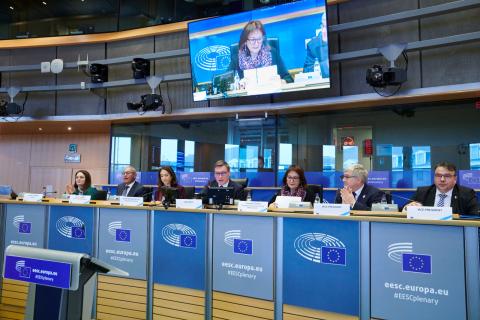
Young people in the Mediterranean region must be included in every step of the way, from policy-making to implementation. They shape not only policies but also life, as highlighted in the debate held by the European Economic and Social Committee (EESC).
The debate linked to the adoption of the opinion on Youth involvement in social and civil dialogue in the Mediterranean region at the EESC’s January plenary is the first opinion to take into account the input of eight youth representatives from the region who participated in the study group meetings.
During the debate, Commissioner Dubravka Šuica for the Mediterranean region stressed the importance of youth for the prosperity, stability and resilience of the region. ‘The future of the Mediterranean is in the hands of its youth. For a shared and sustainable future, we must engage with young generations directly, ensuring their voices guide our policies and priorities. Together, we will shape the new pact for the Mediterranean by investing in education, jobs and growth.’
EESC President Oliver Röpke first welcomed the ceasefires in Gaza and Lebanon as important steps toward peace and humanitarian relief, also noting that the EU’s future is deeply intertwined with the stability and prosperity of our Southern neighbours. He then gave his support for Commissioner Šuica’s new pact that targets investment, sustainability and migration, adding that civil society must be actively involved in its design. ‘Youth engagement is essential for the region’s future, and the EESC is committed to ensuring their voices shape policy and decision-making. Together with the Union for the Mediterranean and the Anna Lindh Foundation, we strive to build a peaceful and thriving Mediterranean.’
The EESC opinion recommends including youth representatives in every youth-focused legal activity and involving young people in all stages of the policy-making process – from implementation to evaluation. Given the lack of adequate frameworks for effective social dialogue in the Mediterranean, the Committee stresses the need to strengthen social dialogue at national, sectoral and company levels.
Underlining the importance of the young representatives’ input in the opinion, Princess Rym Ali, President of the Anna Lindh Foundation, mentioned that working with young people is not only important, but urgent and promising. ‘There is so much at stake. Without the buy-in of youth, offering them tools to participate equally, we cannot have a solution on the future. They need a seat at the table’, she said.
Eliane El Haber, youth representative for the opinion and advisor at UNESCO Sustainable Development Goal 4 Youth & Student Network, embraced the EESC’s initiative to actively engage young people who represent diverse regional, gender, educational and cultural backgrounds.
Additional quotes
Nasser Kamel, Secretary-General of the Union for the Mediterranean, said ‘the Mediterranean Sea is not a dividing line, but a bridge between countries and cultures. The Union for the Mediterranean is ready to work with the EU and its partners to ensure regional dialogues that lead to concrete action, where no one is left behind’.
Thomas Wagnsonner, EESC member and rapporteur for the opinion, said that ‘young people must be actively involved in all stages of the political process. This also applies to social and civic dialogue. That is why the European Commission must actively support a third phase of the South Mediterranean Social Dialogue project to develop a youth charter for the active participation of young people in social and civic dialogue’.
Lidija Pavić-Rogošić, EESC member and co-rapporteur for the opinion, added that ‘in many countries, young people encounter difficulties in civil dialogue processes, which are the basis of democratic participation. Participatory mechanisms characterised by civil freedom, transparency, access to information and opportunities for all should therefore be supported. It is important to design youth strategies that strengthen the legitimacy of their participation in civil dialogue, establish youth councils in countries where they do not exist, and increase youth budgets at all territorial levels’.
Work organisation
Downloads
-
Youth is the key for the EU-Mediterranean partnership
Recommended for you
Η εργαλειοποίηση των μεταναστών και η προσφυγική κρίση της Ουκρανίας επιβάλλουν ένα νέο ξεκίνημα για τη μεταναστευτική πολιτική
News
Η κρατική εργαλειοποίηση των μεταναστών, που αποσκοπεί στην αποσταθεροποίηση της ΕΕ, και ο τρέχων πόλεμος στην Ουκρανία, που οδηγεί σε πρωτόγνωρη εισροή προσφύγων, επιβάλλουν την επανεξέταση της…
YEYS! 2023: Οι νέοι ζητούν μια πιο διαφανή, ψηφιακή και απλοποιημένη ΕΕ
News
Στις 23 και 24 Μαρτίου, η Ευρωπαϊκή Οικονομική και Κοινωνική Επιτροπή (ΕΟΚΕ) φιλοξένησε την 14η διοργάνωση της εκδήλωσης «Η δική σου Ευρώπη, η δική σου φωνή!» (YEYS!), η οποία προσέλκυσε στις…
Η ΕΕ χρειάζεται αποτελεσματικότερη πολυμέρεια για την αντιμετώπιση των κινδύνων που σχετίζονται με την ασφάλεια στη θάλασσα, επισημαίνει η ΕΟΚΕ
News
Η Ευρωπαϊκή Οικονομική και Κοινωνική Επιτροπή (ΕΟΚΕ) ζητεί περισσότερες κοινές δράσεις σχετικά με τη στρατηγική της ΕΕ για την ασφάλεια στη θάλασσα και το σχετικό σχέδιο δράσης, που αποσκοπούν στη…
Η ΕΟΚΕ δρομολογεί τη διαδικασία υποβολής υποψηφιοτήτων για το Βραβείο της Κοινωνίας των Πολιτών, το οποίο θα αφορά την ψυχική υγεία
News
Οι οργανώσεις της κοινωνίας των πολιτών, οι ιδιώτες και οι ιδιωτικές εταιρείες μπορούν τώρα να υποβάλουν τα μη κερδοσκοπικά έργα τους για το βραβείο της ΕΟΚΕ που είναι αφιερωμένο στη στήριξη της…
#ReskillEU — Το εργατικό δυναμικό της Ευρώπης στους τομείς της ενέργειας και των μεταφορών χρειάζεται νέες δεξιότητες για να κάνει πραγματικότητα την απανθρακοποίηση
News
Για να επιτύχει η απανθρακοποίηση των τομέων της ενέργειας και των μεταφορών της ΕΕ, οι εν λόγω τομείς χρειάζονται εργαζομένους εξοπλισμένους με «νέες» δεξιότητες, προειδοποιεί η Ευρωπαϊκή Οικονομική…