
European Economic
and Social Committee
Youth is the key for the EU-Mediterranean partnership
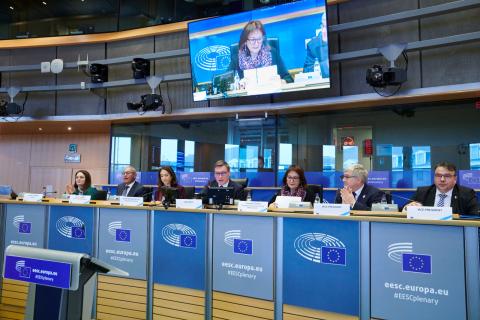
Young people in the Mediterranean region must be included in every step of the way, from policy-making to implementation. They shape not only policies but also life, as highlighted in the debate held by the European Economic and Social Committee (EESC).
The debate linked to the adoption of the opinion on Youth involvement in social and civil dialogue in the Mediterranean region at the EESC’s January plenary is the first opinion to take into account the input of eight youth representatives from the region who participated in the study group meetings.
During the debate, Commissioner Dubravka Šuica for the Mediterranean region stressed the importance of youth for the prosperity, stability and resilience of the region. ‘The future of the Mediterranean is in the hands of its youth. For a shared and sustainable future, we must engage with young generations directly, ensuring their voices guide our policies and priorities. Together, we will shape the new pact for the Mediterranean by investing in education, jobs and growth.’
EESC President Oliver Röpke first welcomed the ceasefires in Gaza and Lebanon as important steps toward peace and humanitarian relief, also noting that the EU’s future is deeply intertwined with the stability and prosperity of our Southern neighbours. He then gave his support for Commissioner Šuica’s new pact that targets investment, sustainability and migration, adding that civil society must be actively involved in its design. ‘Youth engagement is essential for the region’s future, and the EESC is committed to ensuring their voices shape policy and decision-making. Together with the Union for the Mediterranean and the Anna Lindh Foundation, we strive to build a peaceful and thriving Mediterranean.’
The EESC opinion recommends including youth representatives in every youth-focused legal activity and involving young people in all stages of the policy-making process – from implementation to evaluation. Given the lack of adequate frameworks for effective social dialogue in the Mediterranean, the Committee stresses the need to strengthen social dialogue at national, sectoral and company levels.
Underlining the importance of the young representatives’ input in the opinion, Princess Rym Ali, President of the Anna Lindh Foundation, mentioned that working with young people is not only important, but urgent and promising. ‘There is so much at stake. Without the buy-in of youth, offering them tools to participate equally, we cannot have a solution on the future. They need a seat at the table’, she said.
Eliane El Haber, youth representative for the opinion and advisor at UNESCO Sustainable Development Goal 4 Youth & Student Network, embraced the EESC’s initiative to actively engage young people who represent diverse regional, gender, educational and cultural backgrounds.
Additional quotes
Nasser Kamel, Secretary-General of the Union for the Mediterranean, said ‘the Mediterranean Sea is not a dividing line, but a bridge between countries and cultures. The Union for the Mediterranean is ready to work with the EU and its partners to ensure regional dialogues that lead to concrete action, where no one is left behind’.
Thomas Wagnsonner, EESC member and rapporteur for the opinion, said that ‘young people must be actively involved in all stages of the political process. This also applies to social and civic dialogue. That is why the European Commission must actively support a third phase of the South Mediterranean Social Dialogue project to develop a youth charter for the active participation of young people in social and civic dialogue’.
Lidija Pavić-Rogošić, EESC member and co-rapporteur for the opinion, added that ‘in many countries, young people encounter difficulties in civil dialogue processes, which are the basis of democratic participation. Participatory mechanisms characterised by civil freedom, transparency, access to information and opportunities for all should therefore be supported. It is important to design youth strategies that strengthen the legitimacy of their participation in civil dialogue, establish youth councils in countries where they do not exist, and increase youth budgets at all territorial levels’.
Work organisation
Downloads
-
Youth is the key for the EU-Mediterranean partnership
Recommended for you
YEYS! 2023: Jongeren vragen een EU die transparanter, digitaler en eenvoudiger is
News
Op 23 en 24 maart is bij het Europees Economisch en Sociaal Comité (EESC) de veertiende editie van Jouw Europa, jouw mening! (YEYS!) gehouden. Voor dat evenement kwamen 105 leerlingen van 35 scholen…
De elektriciteitsmarkt van de EU moet worden hervormd
News
Uit een door het Europees Economisch en Sociaal Comité (EESC) georganiseerd debat kwam naar voren dat het van cruciaal belang is de Europese elektriciteitsmarkt aan te passen om de zwakke punten…
Kandidaten kunnen zich nu aanmelden voor de EESC-prijs voor het maatschappelijk middenveld, die dit jaar geestelijke gezondheid als thema heeft
News
Maatschappelijke organisaties, individuen en particuliere ondernemingen kunnen nu met hun non-profitprojecten meedingen naar de EESC-prijs voor het maatschappelijk middenveld, die deze keer in het…
EESC roept de EU-burgers op om in juni 2024 te stemmen voor een verenigd en democratisch Europa
News
Tegen de achtergrond van een wereldwijde achteruitgang van de democratie, welig tierende desinformatie, groeiende ontevredenheid, stijgende inflatie en oorlogsdreiging, staat er veel op het spel bij…
De sociale en burgerdialoog kunnen de EU helpen duurzaam te groeien
News
Slechts enkele dagen na de Europese verkiezingen van 2024 kwamen het Europees Economisch en Sociaal Comité (EESC) en de nationale sociaal-economische raden van de EU bijeen om de stand van zaken van…