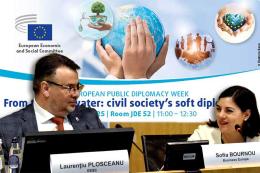
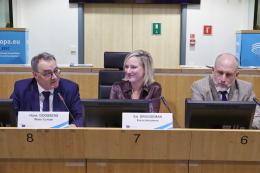
On 25 June 2025, the European Economic and Social Committee (EESC) held an event in the context of European Public Diplomacy Week, launched for the first time by the European External Action Service (EEAS). The participants highlighted a fundamental dimension of European action, the contribution of civil society to public diplomacy, from international trade to water, through enlargement. When official diplomacy has limited outreach due to political or other issues, civil society can provide added value.
The EESC warns that a weak long-term EU budget would undermine competitiveness, cohesion, agriculture and democracy. The Committee calls for a stronger, fairer and future-proof multiannual financial framework (MFF) for 2028 to 2034.
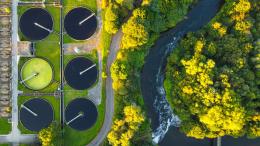
The EESC calls on the EU to focus on water as a driver for peace and stability. In turn, empowering young people, women and indigenous and local communities will lead to greater water security. The EESC's Declaration for an EU Blue Deal therefore calls for water management to be acknowledged as a key concern across all sectors and mainstreamed into all policies.
European Consumer Day 2024 stressed the need for sustainable water management, improved infrastructure and consumer education to make sure water remains affordable to all Europeans
stresses that young people, women, and indigenous and local communities (including migrants and people with disabilities) are the most vulnerable to water stress and have a large untapped potential for contributing to sustainable water management, for turning water into an instrument of peace and stability, and, thus, for contributing to blue diplomacy;
calls on the EU to pay due attention to these groups in its external relations and international cooperation and suggests a lighthouse partnership programme related to water stress for addressing how to empower them in an integrated manner;
notes that access to clean water, education, employment and participation in policymaking are key elements of empowerment;
reaffirms that blue and digital technologies are instrumental for improving water management and access to clean water and sanitation.
The European Economic and Social Committee (EESC) has renewed its call for a dedicated ‘EU Blue Deal’ in the form of a new opinion on water resilience and industrial development, adopted just ahead of Commission President Ursula von der Leyen’s announcement of a Water Resilience Strategy. Europe’s industrial future hinges on water, and a recent Eurobarometer reveals Europeans overwhelmingly support stronger action on water issues.