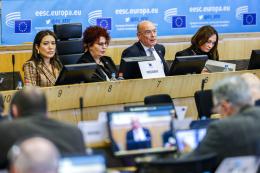
The European Economic and Social Committee (EESC) has renewed its call for a dedicated ‘EU Blue Deal’ in the form of a new opinion on water resilience and industrial development, adopted just ahead of Commission President Ursula von der Leyen’s announcement of a Water Resilience Strategy. Europe’s industrial future hinges on water, and a recent Eurobarometer reveals Europeans overwhelmingly support stronger action on water issues.
On 26 October, the European Economic and Social Committee (EESC) unveiled its plan for a comprehensive EU water strategy. The EESC is leading the way as the first European institution to take concrete steps to address the water crisis. Its proposals include: water consumption labels, a Blue Transition Fund, water conditionality in EU fund, and a dedicated EU Commissioner for water. Read EESC President Oliver Röpke's Declaration for an EU Blue Deal.
Adopting a human rights approach to water management, boosting investments in infrastructure and technologies, introducing water consumption labels and price restructuring are among the key recommendations of the six EESC opinions on water adopted at its July plenary. They make up the first wave of EESC proposals for a comprehensive water policy for Europe under its Blue Deal initiative. On 26 October, the EESC will present its Call for an EU Blue Deal to the EU institutions and stakeholders.
On 13 April 2023, the European Economic and Social Committee (EESC) held a public hearing to address the pressing issue of water poverty and its implications on social policy. The event brought together water experts and stakeholders to mitigate the effects of water poverty, particularly on vulnerable communities. The hearing is part of the EESC's efforts to put water at the top of the EU agenda through a call for an "EU Blue Deal."
As water scarcity and pollution continue to pose global challenges, the current EU policy framework seems insufficient. To address this, top-level water experts gathered on 27 February at the European Economic and Social Committee (EESC) to identify possible solutions. The hearing marks the beginning of the EESC's work on water. The Committee is preparing a set of own-initiative opinions examining the economic, social, environmental, and geopolitical aspects of water and, in the autumn, will share civil society's recommendations for the future of water in the EU.
Event in the framework of the Cyprus Presidency of the Council of the EU
Event type
Conference
Location
Centre for Social Activities and Welfare of the Municipality of Larnaca, Faneromenis 62
Larnaca
Cyprus
Registration for in-person participation will close on Thursday 16 April 2026, noon. Streaming will be available on this page on the day of the event. Prior registration for the streaming is not required.
"Cohesion policy 2028–2034: A new fund, a new framework, a new role for civil society?" brings together EU institutions, social partners and civil society representatives to reflect on the future of cohesion policy in the next Multiannual Financial Framework. The hearing explores proposals for reforming cohesion funding and governance, assesses the implications of the new framework through the National and Regional Partnership Plans and examines how civil society organisations can play a stronger role in the design, implementation and monitoring of cohesion policy. The discussion aims to identify how cohesion policy can continue to deliver territorial, social and economic cohesion while responding to new challenges and transitions facing the European Union.
Public debate in the ECO Section on the Latest twists and turns on the road to the next Multiannual Financial Framework in the framework of the opinion ECO/682 Multiannual financial framework 2028-2034.