stresses that young people, women, and indigenous and local communities (including migrants and people with disabilities) are the most vulnerable to water stress and have a large untapped potential for contributing to sustainable water management, for turning water into an instrument of peace and stability, and, thus, for contributing to blue diplomacy;
calls on the EU to pay due attention to these groups in its external relations and international cooperation and suggests a lighthouse partnership programme related to water stress for addressing how to empower them in an integrated manner;
notes that access to clean water, education, employment and participation in policymaking are key elements of empowerment;
reaffirms that blue and digital technologies are instrumental for improving water management and access to clean water and sanitation.
The European Economic and Social Committee (EESC) has renewed its call for a dedicated ‘EU Blue Deal’ in the form of a new opinion on water resilience and industrial development, adopted just ahead of Commission President Ursula von der Leyen’s announcement of a Water Resilience Strategy. Europe’s industrial future hinges on water, and a recent Eurobarometer reveals Europeans overwhelmingly support stronger action on water issues.
On 26 October, the European Economic and Social Committee (EESC) unveiled its plan for a comprehensive EU water strategy. The EESC is leading the way as the first European institution to take concrete steps to address the water crisis. Its proposals include: water consumption labels, a Blue Transition Fund, water conditionality in EU fund, and a dedicated EU Commissioner for water. Read EESC President Oliver Röpke's Declaration for an EU Blue Deal.
L’adoption d’une approche fondée sur les droits de l’homme en ce qui concerne la gestion de l’eau, la stimulation des investissements dans les infrastructures et les technologies, l’introduction d’un étiquetage relatif à la consommation d’eau et la restructuration des prix figurent parmi les principales recommandations des six avis sur l’eau que le CESE a adoptés lors de sa session plénière de juillet. Ces documents constituent la première vague de propositions du Comité en faveur d’une politique globale de l’eau pour l’Europe dans le cadre de son initiative du «pacte bleu». Le 26 octobre prochain, le CESE présentera son appel en faveur d’un «pacte bleu» pour l’Europe aux institutions et aux parties prenantes de l’UE.
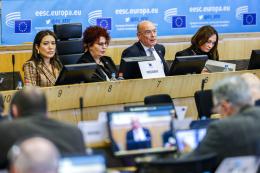
On 13 April 2023, the European Economic and Social Committee (EESC) held a public hearing to address the pressing issue of water poverty and its implications on social policy. The event brought together water experts and stakeholders to mitigate the effects of water poverty, particularly on vulnerable communities. The hearing is part of the EESC's efforts to put water at the top of the EU agenda through a call for an "EU Blue Deal."
Le cadre politique de l’Union européenne semble insuffisant au vu des défis que la rareté de l’eau et sa pollution continuent de représenter à l’échelle mondiale. Pour y remédier, des experts de haut niveau se sont réunis le 27 février dernier au Comité économique et social européen (CESE), afin de trouver des pistes de solutions. L’audition marque le début des travaux du CESE sur le thème de l’eau. Le Comité prépare actuellement une série d’avis d’initiative portant sur les aspects économiques, sociaux, environnementaux et géopolitiques de cette ressource. À l’automne, il partagera les recommandations de la société civile sur l’avenir de l’eau au sein de l’Union.
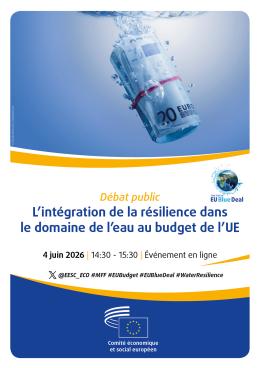
L'intégration de la résilience dans le domaine de l'eau au budget de l'UE est un sujet d’actualité pour garantir l’avenir de l’eau en Europe. Découvrez comment des investissements européens plus judicieux peuvent renforcer la résilience, la durabilité et la préparation en matière d’eau, et comment définir les priorités de financement des programmes de demain dans le cadre du prochain cadre financier pluriannuel de l’UE.
Conférence dans le cadre de la présidence chypriote du Conseil de l'UE
Event type
Conference
Location
Centre d’aide et d’activités sociales de la municipalité de Larnaca, Faneromenis 62
Larnaca
Cyprus
Les inscriptions pour participer en présentiel sont désormais closes. La diffusion en direct sera disponible sur cette page le jour de l'événement. Aucune inscription préalable n'est requise pour accéder à la diffusion en direct.