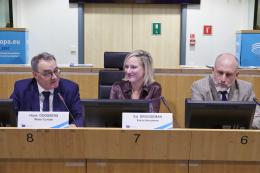
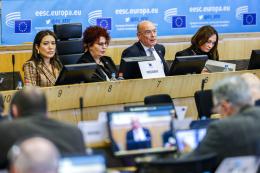
Water resilience was the focus as the European Economic and Social Committee (EESC) met in Nicosia for its Extraordinary Bureau Meeting under the incoming Cypriot Presidency of the Council of the EU. Civil society representatives, experts and policy makers examined Europe’s water challenges and explored coordinated solutions.
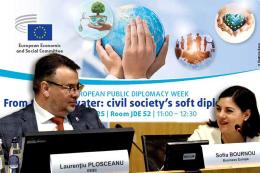
On 25 June 2025, the European Economic and Social Committee (EESC) held an event in the context of European Public Diplomacy Week, launched for the first time by the European External Action Service (EEAS). The participants highlighted a fundamental dimension of European action, the contribution of civil society to public diplomacy, from international trade to water, through enlargement. When official diplomacy has limited outreach due to political or other issues, civil society can provide added value.
The EESC calls on the EU to focus on water as a driver for peace and stability. In turn, empowering young people, women and indigenous and local communities will lead to greater water security. The EESC's Declaration for an EU Blue Deal therefore calls for water management to be acknowledged as a key concern across all sectors and mainstreamed into all policies.
European Consumer Day 2024 stressed the need for sustainable water management, improved infrastructure and consumer education to make sure water remains affordable to all Europeans
stresses that young people, women, and indigenous and local communities (including migrants and people with disabilities) are the most vulnerable to water stress and have a large untapped potential for contributing to sustainable water management, for turning water into an instrument of peace and stability, and, thus, for contributing to blue diplomacy;
calls on the EU to pay due attention to these groups in its external relations and international cooperation and suggests a lighthouse partnership programme related to water stress for addressing how to empower them in an integrated manner;
notes that access to clean water, education, employment and participation in policymaking are key elements of empowerment;
reaffirms that blue and digital technologies are instrumental for improving water management and access to clean water and sanitation.
The European Economic and Social Committee (EESC) has renewed its call for a dedicated ‘EU Blue Deal’ in the form of a new opinion on water resilience and industrial development, adopted just ahead of Commission President Ursula von der Leyen’s announcement of a Water Resilience Strategy. Europe’s industrial future hinges on water, and a recent Eurobarometer reveals Europeans overwhelmingly support stronger action on water issues.
On 26 October, the European Economic and Social Committee (EESC) unveiled its plan for a comprehensive EU water strategy. The EESC is leading the way as the first European institution to take concrete steps to address the water crisis. Its proposals include: water consumption labels, a Blue Transition Fund, water conditionality in EU fund, and a dedicated EU Commissioner for water. Read EESC President Oliver Röpke's Declaration for an EU Blue Deal.
Adopting a human rights approach to water management, boosting investments in infrastructure and technologies, introducing water consumption labels and price restructuring are among the key recommendations of the six EESC opinions on water adopted at its July plenary. They make up the first wave of EESC proposals for a comprehensive water policy for Europe under its Blue Deal initiative. On 26 October, the EESC will present its Call for an EU Blue Deal to the EU institutions and stakeholders.
On 13 April 2023, the European Economic and Social Committee (EESC) held a public hearing to address the pressing issue of water poverty and its implications on social policy. The event brought together water experts and stakeholders to mitigate the effects of water poverty, particularly on vulnerable communities. The hearing is part of the EESC's efforts to put water at the top of the EU agenda through a call for an "EU Blue Deal."
As water scarcity and pollution continue to pose global challenges, the current EU policy framework seems insufficient. To address this, top-level water experts gathered on 27 February at the European Economic and Social Committee (EESC) to identify possible solutions. The hearing marks the beginning of the EESC's work on water. The Committee is preparing a set of own-initiative opinions examining the economic, social, environmental, and geopolitical aspects of water and, in the autumn, will share civil society's recommendations for the future of water in the EU.