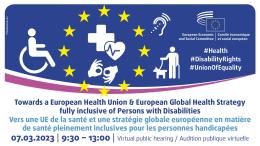
The EESC is organising a hybrid public hearing on "Towards a European Health Union and European Global Health Strategy fully inclusive of Persons with Disabilities " on 7th March 2023 am ( 9:30 am to 1 pm).
Despite being recognized by the UN Convention on the Rights of persons with Disabilities (UNCRPD) the right to the enjoyment of the highest attainable standard of health, persons with disabilities (pwd) are still victims of discrimination in access to healthcare both in the EU and at global level. The hearing, organised by the EESC Permanent Group on Disability Rights, will discuss what can be done to advance the rights of pwd in the field of health within the European Health Union and the EU Global Health Strategy.
believes that the non-mutual recognition of disability among EU Member States, by hindering the availability of support measures for persons with disabilities traveling to another member State, implies a denial of their freedom of movement.
Recommends that the EU Disability Card is implemented by a Regulation, that PWDs and their organization are fully involved in each step leading to its implementation and monitoring, and that complementary measures are taken to ensure accessibility of transport, services and of the built environment and compliance with the General Data Protection Regulation
Believes that the EU Disability Card and EU parking Card remain physically separate
Download format:
Download — stanovisko EHSV: European Disability Card
The EESC is organising a public hearing on "Climate justice and how it is affecting people with disabilities in Europe and in the world" on 19 October 2022.
Climate justice is a concept that addresses the just division, fair sharing, and equitable distribution of the benefits and burdens of climate change and responsibilities to deal with it.
People with disabilities, especially those living in low income countries, are among those most impacted by climate change. In addition, their human rights are most at risk of violation by inappropriate climate action. To avoid this, their meaningful participation in climate policy forums for the development of climate adaptation and mitigation plans is needed.
The aim of the event is to identify necessary steps to reach disability inclusive climate justice.
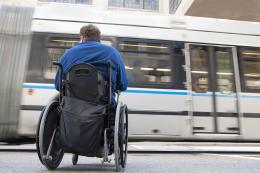
Many people take it for granted that they can move around freely and travel spontaneously by using public transport. But for people with reduced mobility, this is often not possible, due to a lack of accessibility arrangements. To discuss these matters, the European Economic and Social Committee (EESC) has held a public hearing
the explosion of the phenomenon during the pandemic
Location
Interactio and Room JDE 60, EESC building, Rue Belliard 99, 1040
Brussels
Belgium
In order to prepare its own initiative opinion on "The role of family members caring for people with disabilities and the elderly: the explosion of the phenomenon during the pandemic", the EESC is organising a remote public hearing on 4 July 2022 from 9:30 am to 1 pm.
The aim of the event is to gather input from policy makers, civil society organisations and social partners, which will feed into the EESC's opinion.
The EESC is organising a public hearing on "Transport Accessibility for persons with disabilities" on 23 June 2022.
The aim of the event is to reflect on which steps the EU could take to make progress on this topic, in particular by identifying the existing barriers and obstacles and good practices and to offer a space for debate to organisations representing persons with disabilities and other stakeholders.
An EESC hearing points to the need to increase the employment rate of persons with disabilities, especially young people. Despite legal efforts, data shows that many of them are still facing discrimination in the world of work due to stereotypes portraying them as unproductive.
This opinion draws attention to the needs of family members taking care of older, chronic ill or disabled relatives. Informal carers, as they are called, represented by a majority of women, work for free, and are more vulnerable to falling into poverty. The opinion calls for public policies in this field and a recognition of their important societal role.
Download format:
Download — stanovisko EHSV: The role of family members caring for people with disabilities and older persons: the explosion of the phenomenon during the pandemic