
European Economic
and Social Committee
Restoring sustainable carbon cycles: for the EESC, achieving carbon neutrality requires a holistic approach
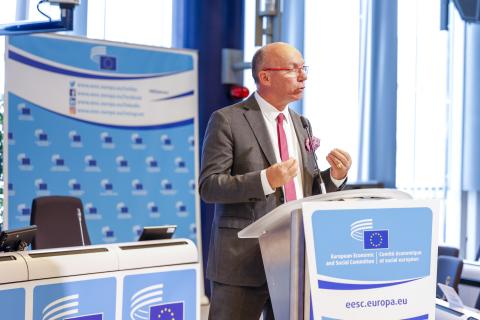
The European Economic and Social Committee (EESC) supports the key messages of the European Commission's Communication on Sustainable Carbon Cycles in an opinion adopted at its May plenary, and believes that the Common Agricultural Policy (CAP) must provide a strategic framework paving the way for a low-carbon transition in agriculture.
Responding to the climate emergency, the European Union has put its goal of achieving climate neutrality by 2050 into law. To achieve such an ambitious objective, sustainable and climate-resilient carbon cycles must be established through a holistic approach, which includes recycling carbon from waste streams, from sustainable sources of biomass or directly from the atmosphere, taking into consideration that increasing carbon sinks and replacing fossil carbon will require more biomass to be produced, which will affect the land sector.
Finding a solution to carbon neutrality requires that we change our practices by reducing greenhouse gas emissions, finding green alternatives to fossil carbon, and increasing carbon sinks
, said the rapporteur of the opinion Arnold Puech d'Alissac. The EESC supports the two solutions proposed by the Commission for removing and sequestering carbon: nature-based solutions and industrial technological solutions. However, we recognise that some challenges for certified carbon sequestration identified in the communication are still unsolved
, he added.
Carbon sequestration will be a key component of European agriculture and forestry in the future, and should therefore not only be seen as a commercial opportunity. It is also a tool for climate action and contributes to more resilient and sustainable rural areas, in line with the long-term vision for EU rural areas.
The Committee also highlights the critical role that the CAP must play in providing a policy framework paving the way for the low-carbon transition in agriculture, whereby the sector will emit less and sequester more. The investment support in the CAP can and should reward carbon storage financially as an eco-service and income support for farmers; however, carbon storage should not be a condition of the CAP and a specific market must be further promoted. The EESC further considers that the development of carbon sequestration will require a clear legal framework. The agricultural sector will have to adapt in order to successfully develop sustainable carbon cycles while contributing to the broader transition to sustainable food systems.
The EESC also stresses that industrial solutions, such as permanent CO2 storage in geological formations, will have to be sustainable and prevent negative impacts on biodiversity, ecosystems and communities.
The well-being of workers, as well as the need for fair remuneration, should also be taken into account so that farmers and workers will commit to, and make a success of, the transition to a low-carbon economy.
Background
In December 2021, the Commission adopted the Communication on Sustainable Carbon Cycles, which sets out an action plan on how to develop sustainable solutions to increase carbon removals. The Communication highlights several key "challenges" and proposes short- to medium-term actions to tackle them. The EESC opinion supports the Communication on Sustainable Carbon Cycles, while highlighting that some challenges for certified carbon sequestration remain unanswered, and adds its say to the regulatory framework for the certification of carbon removals. By the end of 2022, the Commission will propose an EU regulatory framework for the certification of carbon removals based on robust and transparent carbon accounting rules to monitor and verify the authenticity and environmental integrity of carbon removals.
Work organisation
Recommended for you
Pro odolnost EU má zásadní význam aktivní úloha organizované občanské společnosti
News
Na plenárním zasedání EHSV se diskutovalo o tom, jak roste význam organizované občanské společnosti a měst, neboť ovlivňují schopnost Evropy čelit asymetrickým otřesům a neočekávaným…
Mladí lidé coby hybatelé změn a evropské integrace zemí západního Balkánu
News
V rámci konference občanské společnosti na vysoké úrovni na téma Politika v oblasti mládeže v zemích západního Balkánu, kterou uspořádal Evropský hospodářský a sociální výbor (EHSV),…
České předsednictví chce dát Evropě nové pojetí, novou podobu a nový impuls
News
Jedním z bodů červencového plenárního zasedání Evropského hospodářského a sociálního výboru (EHSV) byla diskuse s českým ministrem zahraničních věcí Janem Lipavským o…
Vaše Evropa, váš názor (YEYS!) 2023: Mladí lidé požadují transparentnější, digitálnější a zjednodušenou EU
News
Evropský hospodářský a sociální výbor (EHSV) uspořádal ve dnech 23. a 24. března 14. ročník akce Vaše Evropa, váš názor (YEYS!). V jejím rámci se v Bruselu sešlo 105 studentů z 35 škol ze všech 27…
Spravedlivý přechod na nízkouhlíkovou společnost není možný bez účasti občanské společnosti
News
Dolní Vítkovice v Ostravě jsou bývalou průmyslovou oblastí, kde se dříve těžilo uhlí a vyráběla ocel. 11. října 2022 se zde na konferenci sešli zástupci akademické obce, místních…