
European Economic
and Social Committee
Restoring sustainable carbon cycles: for the EESC, achieving carbon neutrality requires a holistic approach
The European Economic and Social Committee (EESC) supports the key messages of the European Commission's Communication on Sustainable Carbon Cycles in an opinion adopted at its May plenary, and believes that the Common Agricultural Policy (CAP) must provide a strategic framework paving the way for a low-carbon transition in agriculture.
Responding to the climate emergency, the European Union has put its goal of achieving climate neutrality by 2050 into law. To achieve such an ambitious objective, sustainable and climate-resilient carbon cycles must be established through a holistic approach, which includes recycling carbon from waste streams, from sustainable sources of biomass or directly from the atmosphere, taking into consideration that increasing carbon sinks and replacing fossil carbon will require more biomass to be produced, which will affect the land sector.
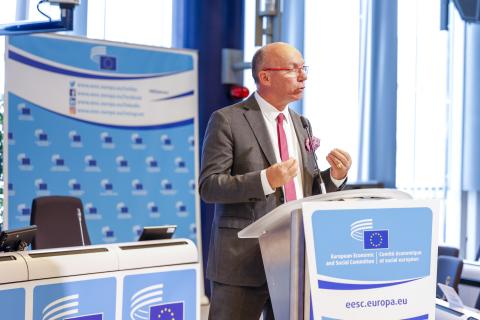
Finding a solution to carbon neutrality requires that we change our practices by reducing greenhouse gas emissions, finding green alternatives to fossil carbon, and increasing carbon sinks
, said the rapporteur of the opinion Arnold Puech d'Alissac. The EESC supports the two solutions proposed by the Commission for removing and sequestering carbon: nature-based solutions and industrial technological solutions. However, we recognise that some challenges for certified carbon sequestration identified in the communication are still unsolved
, he added.
Carbon sequestration will be a key component of European agriculture and forestry in the future, and should therefore not only be seen as a commercial opportunity. It is also a tool for climate action and contributes to more resilient and sustainable rural areas, in line with the long-term vision for EU rural areas.
The Committee also highlights the critical role that the CAP must play in providing a policy framework paving the way for the low-carbon transition in agriculture, whereby the sector will emit less and sequester more. The investment support in the CAP can and should reward carbon storage financially as an eco-service and income support for farmers; however, carbon storage should not be a condition of the CAP and a specific market must be further promoted. The EESC further considers that the development of carbon sequestration will require a clear legal framework. The agricultural sector will have to adapt in order to successfully develop sustainable carbon cycles while contributing to the broader transition to sustainable food systems.
The EESC also stresses that industrial solutions, such as permanent CO2 storage in geological formations, will have to be sustainable and prevent negative impacts on biodiversity, ecosystems and communities.
The well-being of workers, as well as the need for fair remuneration, should also be taken into account so that farmers and workers will commit to, and make a success of, the transition to a low-carbon economy.
Background
In December 2021, the Commission adopted the Communication on Sustainable Carbon Cycles, which sets out an action plan on how to develop sustainable solutions to increase carbon removals. The Communication highlights several key "challenges" and proposes short- to medium-term actions to tackle them. The EESC opinion supports the Communication on Sustainable Carbon Cycles, while highlighting that some challenges for certified carbon sequestration remain unanswered, and adds its say to the regulatory framework for the certification of carbon removals. By the end of 2022, the Commission will propose an EU regulatory framework for the certification of carbon removals based on robust and transparent carbon accounting rules to monitor and verify the authenticity and environmental integrity of carbon removals.
Work organisation
Recommended for you
Presidentes do CESE e do CR debatem desafios comuns para o futuro da Europa
News
Na reunião plenária de julho do Comité Económico e Social Europeu (CESE), a sua presidente, Christa Schweng, e o presidente recentemente eleito do Comité das Regiões Europeu (CR), Vasco Alves…
Movimento Transformers entre os finalistas do Prémio CESE para a Sociedade Civil dedicado à juventude
News
A associação sem fins lucrativos portuguesa Movimento Transformers figura na lista de finalistas do Prémio CESE para a Sociedade Civil de 2022 que, este ano, é atribuído a duas categorias, a saber,…
Associação portuguesa Movimento Transformers recebe Prémio CESE para a Sociedade Civil 2022 pelo apoio a jovens desfavorecidos
News
O Movimento Transformers é uma das organizações sem fins lucrativos que o Comité Económico e Social Europeu (CESE) distinguiu pelos seus projetos em prol da juventude. O Movimento Transformers…
«A tua Europa, a tua voz!» de 2023: jovens reclamam uma UE mais transparente, digital e simplificada
News
Em 23 e 24 de março, o Comité Económico e Social Europeu (CESE) acolheu a 14.ª edição do evento «A tua Europa, a tua voz!», que reuniu em Bruxelas 105 alunos de 35 escolas dos 27 Estados‑Membros da…
#RareDiseases – UE precisa de estratégia para ajudar 36 milhões de pessoas com doenças raras na Europa
News
Na conferência que organizou em Bilbau, o Comité Económico e Social Europeu (CESE) instou a União Europeia a lançar um plano de ação europeu para reforçar a cooperação entre os sistemas nacionais de…