
European Economic
and Social Committee
Restoring sustainable carbon cycles: for the EESC, achieving carbon neutrality requires a holistic approach
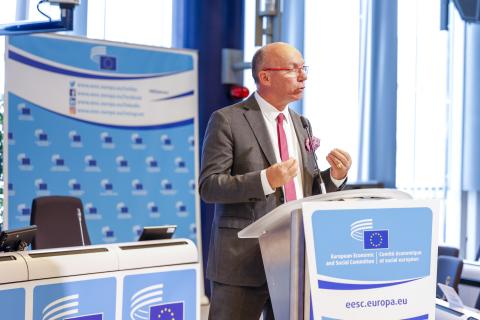
The European Economic and Social Committee (EESC) supports the key messages of the European Commission's Communication on Sustainable Carbon Cycles in an opinion adopted at its May plenary, and believes that the Common Agricultural Policy (CAP) must provide a strategic framework paving the way for a low-carbon transition in agriculture.
Responding to the climate emergency, the European Union has put its goal of achieving climate neutrality by 2050 into law. To achieve such an ambitious objective, sustainable and climate-resilient carbon cycles must be established through a holistic approach, which includes recycling carbon from waste streams, from sustainable sources of biomass or directly from the atmosphere, taking into consideration that increasing carbon sinks and replacing fossil carbon will require more biomass to be produced, which will affect the land sector.
Finding a solution to carbon neutrality requires that we change our practices by reducing greenhouse gas emissions, finding green alternatives to fossil carbon, and increasing carbon sinks
, said the rapporteur of the opinion Arnold Puech d'Alissac. The EESC supports the two solutions proposed by the Commission for removing and sequestering carbon: nature-based solutions and industrial technological solutions. However, we recognise that some challenges for certified carbon sequestration identified in the communication are still unsolved
, he added.
Carbon sequestration will be a key component of European agriculture and forestry in the future, and should therefore not only be seen as a commercial opportunity. It is also a tool for climate action and contributes to more resilient and sustainable rural areas, in line with the long-term vision for EU rural areas.
The Committee also highlights the critical role that the CAP must play in providing a policy framework paving the way for the low-carbon transition in agriculture, whereby the sector will emit less and sequester more. The investment support in the CAP can and should reward carbon storage financially as an eco-service and income support for farmers; however, carbon storage should not be a condition of the CAP and a specific market must be further promoted. The EESC further considers that the development of carbon sequestration will require a clear legal framework. The agricultural sector will have to adapt in order to successfully develop sustainable carbon cycles while contributing to the broader transition to sustainable food systems.
The EESC also stresses that industrial solutions, such as permanent CO2 storage in geological formations, will have to be sustainable and prevent negative impacts on biodiversity, ecosystems and communities.
The well-being of workers, as well as the need for fair remuneration, should also be taken into account so that farmers and workers will commit to, and make a success of, the transition to a low-carbon economy.
Background
In December 2021, the Commission adopted the Communication on Sustainable Carbon Cycles, which sets out an action plan on how to develop sustainable solutions to increase carbon removals. The Communication highlights several key "challenges" and proposes short- to medium-term actions to tackle them. The EESC opinion supports the Communication on Sustainable Carbon Cycles, while highlighting that some challenges for certified carbon sequestration remain unanswered, and adds its say to the regulatory framework for the certification of carbon removals. By the end of 2022, the Commission will propose an EU regulatory framework for the certification of carbon removals based on robust and transparent carbon accounting rules to monitor and verify the authenticity and environmental integrity of carbon removals.
Work organisation
Recommended for you
Toghadh Séamus Boland ina Uachtarán ar Choiste Eacnamaíoch agus Sóisialta na hEorpa, agus gheall sé go gcuirfear an tsochaí shibhialta i gcroílár na hEorpa
News
Toghadh Séamus Boland na hÉireann ar an 35ú Uachtarán ar Choiste Eacnamaíoch agus Sóisialta na hEorpa (CESE) le haghaidh an téarma oifige 2025-2028. Is urlabhra riamh anall é do phobail na tuaithe…
CESE, Uachtarántacht na hÉireann agus an fhís choiteann atá acu
News
I ndiaidh na díospóireachta a reáchtáladh le Comhaltaí CESE le linn sheisiún iomlánach mhí Iúil, níl aon dabht faoi ach go bhfuil clár Uachtaránacht reatha an Aontais ag freagairt go mór do na…
#YEYS2022: Ceist na bréagaisnéise pléite ag aos óg na hEorpa agus a dtuairimí ina leith curtha in iúl acu don Leas-Uachtarán Jourová
News
Chuir daltaí meánscoile ó gach cearn den Eoraip ocht gcinn de thograí nithiúla faoi bhráid Leas-Uachtarán an Choimisiúin Eorpaigh um Luachanna agus um Thrédhearcacht, Věra Jourová. Bhí páirt á…
#CivilsocietyforUkraine
News
Cáineann CESE ionradh Rialtas na Rúise ar an Úcráin, ionradh atá gan údar agus gan chúis Rún ó Choiste Eacnamaíoch agus Sóisialta na hEorpa (CESE) maidir leis an gcogadh san Úcráin agus an tionchar…
Eagrán speisialta de CESE info
News
Eagrán speisialta de CESE info atá dírithe ar an Úcráin. Is féidir scéal Tetyana Ogarkova a léamh, bean a chuala fuaim ionradh na Rúise ar dhúiseacht di an 24 Feabhra.