This own-initiative opinion will draw upon the first-hand experiences of the non-state actors (civil society, business and trade unions) engaged in the accession negotiations between Croatia and the EU over the period 2005-11, as well as experiences of EESC members who have been engaged in the work of Joint Consultative Committees (JCCs) with accession countries over the past seven years (Croatia, the former Yugoslav Republic of Macedonia, Turkey and Montenegro) as well as the Western Balkans Follow-up Committee.
Download — Enhancing the transparency and inclusiveness of the EU accession process
The opinion should take stock of the current situation of civil society in Serbia (legal environment, relations with the authorities, situation of social and civil dialogues) and propose recommendations for possible EU action in this field. The opinion will provide an opportunity to get the views of Serbian civil society organisations in the course of a study visit to Serbia.
Download — The role of civil society in EU-Serbia relations
Democracy, human rights, and the rule of law are the foundation of the European Union's identity. Within these values lies the right to peaceful assembly, a fundamental freedom enshrined in the Universal Declaration of Human Rights, European Charter of Fundamental rights and the European Convention on Human Rights. As the House of the European organised civil society, the EESC has always fervently defended it.
Media freedom is a vital component of any functioning democracy. As strong supporters of Serbia's EU accession process with a particular accent on fulfilment of Fundamentals criteria, ...
We strongly support the enlargement of the EU to embrace its Western Balkans partners providing that they fulfil all criteria for membership, with a particular accent on the Fundamentals. ...
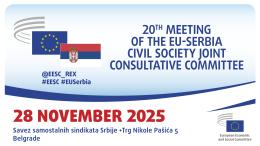
The EU-Serbia Joint Consultative Committee (JCC) held its 20th meeting on 28 November 2025 in Serbia. This platform, established within the institutional framework of the EU-Serbia Stabilisation and Association Agreement (SAA), will enable representatives from both the EU and Serbian civil society to monitor the country's accession negotiations, discuss issues of common interest, and highlight concerns to be addressed on Serbia's path towards the European Union.
Accelerating Socio-Economic Convergence with the EU for a Better Life
-
Location
Hotel Splendid Conference & Spa Resort
Bečići bb
Budva
Montenegro
The 10th Western Balkans Civil Society Forum took place in Montenegro on 13-14 May 2024. The forum was hold in Montenegro to encourage the country to fulfil its ambition of becoming the next EU member state by 2028 and to serve as a positive example for the rest of the region. This event will represent a significant contribution from organised civil society to the European Commission's 2025 Enlargement Package.
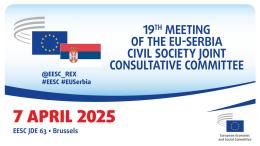
The EU-Serbia Joint Consultative Committee (JCC) held its 19th meeting on 7 April 2025 at the EESC in Brussels. This platform, established within the institutional framework of the EU-Serbia Stabilisation and Association Agreement (SAA), will enable representatives from both the EU and Serbian civil society to monitor the country's accession negotiations, discuss issues of common interest, and highlight concerns to be addressed on Serbia's path towards the European Union.
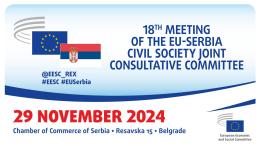
The EU-Serbia Joint Consultative Committee (JCC) held its 18th meeting on 29 November 2024 at the EESC in Belgrade, Serbia. It is a platform established within the institutional framework of the EU‑Serbia Stabilisation and Association Agreement (SAA), enabling representatives of both the EU and the Serbian civil society to monitor the country's accession negotiations, discuss issues of common interest and point out concerns to be tackled on the Serbian path towards the European Union.
The EU-Serbia Joint Consultative Committee (JCC) held its 17th meeting on 5 April 2024 at the EESC in Brussels, Belgium. It is a platform established within the institutional framework of the EU‑Serbia Stabilisation and Association Agreement (SAA), enabling representatives of both the EU and the Serbian civil society to monitor the country's accession negotiations, discuss issues of common interest and point out concerns to be tackled on the Serbian path towards the European Union.