
European Economic
and Social Committee
Civil Society should be a driving force in democracy, emphasised participants at the EESC hearing in Sarajevo
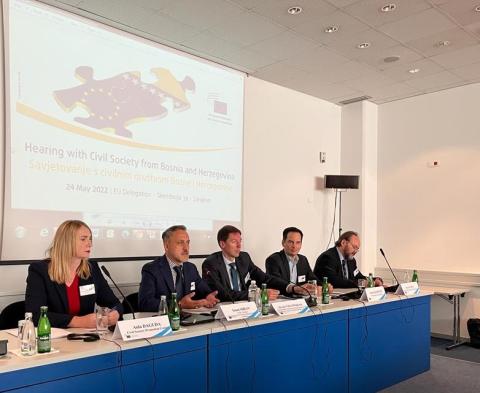
On 24 May in Sarajevo, the EESC's Western Balkans Follow-up Committee held its yearly external meeting - for the first time since the COVID-19 pandemic - to meet with civil society organisations (CSOs) in Bosnia and Herzegovina and discuss their role and concerns regarding the current situation. The conclusions will be conveyed to the country's political authorities and to the EU institutions.
The hearing was hosted at the EU Delegation in Sarajevo and was attended by more than 60 participants, who expressed their views on the state of civic and social dialogue, media freedom and the fight against disinformation, as well as the labour market, focussing on young people.
Jurgis Vilcinskas, Acting Deputy Head of the Delegation of the EU to Bosnia and Herzegovina, highlighted that the war in Ukraine is having a negative impact on the economy and security of Bosnia and Herzegovina and that, in these difficult times, the advice of civil society is more valuable than ever.
Ionuţ Sibian, EESC member and president of the Western Balkans Follow-up Committee, underlined that the shrinking of civic space is a problem that affects not only Western Balkan countries such as Bosnia and Herzegovina but also EU Member States. He also stressed that if CSOs in Bosnia and Herzegovina want to receive sustainable funding, they should invest more in developing local infrastructure and partnerships with academia.
According to participants, CSOs need to regain their role in society as result-driven agents of change, as in the last 12 years they have been increasingly marginalised by national authorities and sponsored by foreign donors. The idea of engaging citizens with CSOs was also raised and considerable emphasis was given to youth-related issues. The numbers are very disappointing, showing that many young people are leaving the country due to the lack of job opportunities and the poor educational system. Social dialogue in the country was also described by participants as fragmented and weak.
Regarding freedom of expression, speakers stressed that this is often used as a carte blanche to promote hate speech and argued that the role of social media should be to connect people, rather than as a tool for different political parties to work against cultural diversity in the country. Universities and institutions should play a role in raising awareness of hate speech and in improving media literacy. Journalists, especially female journalists, are still under attack and are seen as enemies by the country's authorities and concrete proposals to sanction these attacks more harshly have failed to be adopted by the national Parliament.
A report will be drafted containing the main messages of the debate and will be distributed to all the relevant stakeholders on 25 May, along with the opinion Youth Policy in the Western Balkans, which is due to be adopted by the EESC this Summer.
Work organisation
Downloads
-
Civil Society should be a driving force in democracy, emphasised participants at the EESC hearing in Sarajevo
Recommended for you
Energi – EESK varnar för nya beroendeförhållanden
News
Europeiska ekonomiska och sociala kommittén (EESK) intar en fast hållning i energifrågan i ett yttrande som antogs vid dess plenarsession i september: kommissionens förslag är ett steg i rätt…
Svenska rådsordförandeskapet 2023: Ukraina står fortfarande högst upp på dagordningen
News
Vid Europeiska ekonomiska och sociala kommitténs (EESK) plenarsession i januari hölls en debatt under vilken Sveriges EU-minister Jessika Roswall redogjorde för prioriteringarna för det nya…
Ditt Europa, din mening! 2023: Ungdomar efterlyser ett mer transparent, digitalt och förenklat EU
News
Den 23–24 mars stod Europeiska ekonomiska och sociala kommittén (EESK) för 14:e gången värd för ”Ditt Europa, din mening!” (YEYS!) i Bryssel, med 105 elever från 35 skolor från alla 27 EU-länder och…
EESK diskuterar agendan för det svenska EU-ordförandeskapet 2023
News
Vid sammanträdet i Europeiska ekonomiska och sociala kommittén (EESK) i Stockholm redogjorde Sveriges statssekreterare med ansvar för EU-frågor, Christian Danielsson, för den politiska inriktningen…
EU–Ukraina: driftskompatibilitet och solidaritet – nyckelfaktorer för transportförbindelserna
News
Vid en debatt som Europeiska ekonomiska och sociala kommittén (EESK) höll i Bryssel framhöll deltagarna vikten av infrastruktur och harmoniserade standarder för att sammanlänka EU med dess…