
European Economic
and Social Committee
Civil Society should be a driving force in democracy, emphasised participants at the EESC hearing in Sarajevo
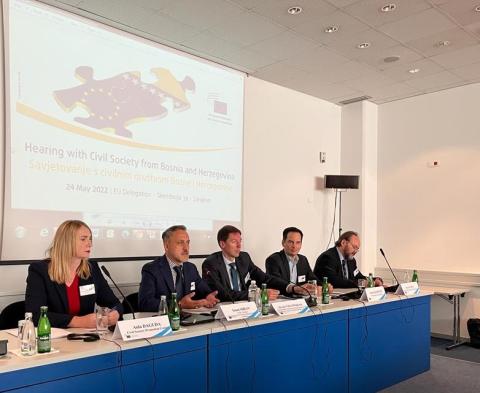
On 24 May in Sarajevo, the EESC's Western Balkans Follow-up Committee held its yearly external meeting - for the first time since the COVID-19 pandemic - to meet with civil society organisations (CSOs) in Bosnia and Herzegovina and discuss their role and concerns regarding the current situation. The conclusions will be conveyed to the country's political authorities and to the EU institutions.
The hearing was hosted at the EU Delegation in Sarajevo and was attended by more than 60 participants, who expressed their views on the state of civic and social dialogue, media freedom and the fight against disinformation, as well as the labour market, focussing on young people.
Jurgis Vilcinskas, Acting Deputy Head of the Delegation of the EU to Bosnia and Herzegovina, highlighted that the war in Ukraine is having a negative impact on the economy and security of Bosnia and Herzegovina and that, in these difficult times, the advice of civil society is more valuable than ever.
Ionuţ Sibian, EESC member and president of the Western Balkans Follow-up Committee, underlined that the shrinking of civic space is a problem that affects not only Western Balkan countries such as Bosnia and Herzegovina but also EU Member States. He also stressed that if CSOs in Bosnia and Herzegovina want to receive sustainable funding, they should invest more in developing local infrastructure and partnerships with academia.
According to participants, CSOs need to regain their role in society as result-driven agents of change, as in the last 12 years they have been increasingly marginalised by national authorities and sponsored by foreign donors. The idea of engaging citizens with CSOs was also raised and considerable emphasis was given to youth-related issues. The numbers are very disappointing, showing that many young people are leaving the country due to the lack of job opportunities and the poor educational system. Social dialogue in the country was also described by participants as fragmented and weak.
Regarding freedom of expression, speakers stressed that this is often used as a carte blanche to promote hate speech and argued that the role of social media should be to connect people, rather than as a tool for different political parties to work against cultural diversity in the country. Universities and institutions should play a role in raising awareness of hate speech and in improving media literacy. Journalists, especially female journalists, are still under attack and are seen as enemies by the country's authorities and concrete proposals to sanction these attacks more harshly have failed to be adopted by the national Parliament.
A report will be drafted containing the main messages of the debate and will be distributed to all the relevant stakeholders on 25 May, along with the opinion Youth Policy in the Western Balkans, which is due to be adopted by the EESC this Summer.
Work organisation
Downloads
-
Civil Society should be a driving force in democracy, emphasised participants at the EESC hearing in Sarajevo
Recommended for you
YEYS! 2023: Mládež žiada transparentnejšiu, digitálnejšiu a jednoduchšiu EÚ
News
Európsky hospodársky a sociálny výbor (EHSV) usporiadal 23. a 24. marca 14. ročník podujatia Vaša Európa, váš názor (YEYS), ktoré priviedlo do Bruselu 105…
Slovenská organizácia Integra získava Cenu EHSV pre občiansku spoločnosť za boj proti stereotypom spájaným s duševnými poruchami
News
Európsky hospodársky a sociálny výbor (EHSV) sa tohto roku rozhodol udeliť Cenu pre občiansku spoločnosť projektom na podporu duševného zdravia. Víťazom sa stala írska charitatívna organizácia…
EHSV otvára nový ročník Ceny pre občiansku spoločnosť, ktorej ústrednou témou je duševné zdravie
News
Organizácie občianskej spoločnosti, jednotlivci a súkromné spoločnosti môžu odteraz predkladať svoje neziskové projekty a uchádzať sa o cenu EHSV venovanú podpore duševnej pohody…
Odovzdajte svoj hlas v európskych voľbách v júni 2024: EHSV vyzýva Európanov, aby hlasovali za zjednotenú a demokratickú Európu
News
Vzhľadom na celosvetový trend ústupu demokracie, rýchle šírenie dezinformácií a zvyšujúcu sa nespokojnosť v dôsledku nárastu inflácie a hrozby vojny, pôjde pri hlasovaní o novom…
Dezinformácie a nedostatok záujmu sú hlavnými príčinami vysokej neúčasti voličov vo voľbách do Európskeho parlamentu
News
Európania musia poznať konkrétny vplyv rozhodnutí EÚ na ich životy, čo ich pomôže mobilizovať sa k účasti na voľbách. Rôznym krajinám EÚ je potrebné prispôsobiť rôzne posolstvá. Je potrebné preto…