European Economic
and Social Committee
European Economic
and Social Committee
The European Economic and Social Committee (EESC) is the voice of organised civil society in Europe.
Find out more about its role and structure at http://www.eesc.europa.eu/en/about
The EESC issues between 160 and 190 opinions, evaluation and information reports a year.
It also organises several annual initiatives and events with a focus on civil society and citizens’ participation such as the Civil Society Prize, the Civil Society Days, the Your Europe, Your Say youth plenary and the ECI Day.
Find the latest EESC opinions and publications at http://www.eesc.europa.eu/en/our-work/opinions-information-reports/opinions and http://www.eesc.europa.eu/en/our-work/publications-other-work/publications respectively.
The EESC is active in a wide range of areas, from social affairs to economy, energy and sustainability.
Learn more about our policy areas and policy highlights at http://www.eesc.europa.eu/en/policies
The EESC holds nine plenary sessions per year. It also organises many conferences, public hearings and high-level debates related to its work.
Find out more about our upcoming events at http://www.eesc.europa.eu/en/agenda/our-events/upcoming-events
Here you can find news and information about the EESC'swork, including its social media accounts, the EESC Info newsletter, photo galleries and videos.
Read the latest EESC news http://www.eesc.europa.eu/en/news-media/news and press releases http://www.eesc.europa.eu/en/news-media/press-releases
The EESC brings together representatives from all areas of organised civil society, who give their independent advice on EU policies and legislation. The EESC's326 Members are organised into three groups: Employers, Workers and Various Interests.
Find out more about our Members and groups at http://www.eesc.europa.eu/en/members-groups
The EESC has six sections, specialising in concrete topics of relevance to the citizens of the European Union, ranging from social to economic affairs, energy, environment, external relations or the internal market.
Find out more at http://www.eesc.europa.eu/en/sections-other-bodies
Vid sin plenarsession i januari diskuterade EESK visionen för EU:s ”strategiska kompass” för säkerhet och försvar, och menade att säkerhet bör förstås i vid mening som mycket mer än militärt försvar. Det civila samhället bör inte vara en passiv aktör när det gäller säkerhetsfrågor. I samband med kriser kan det spela rollen som stabilisator, vilket kriget i Ukraina har visat.
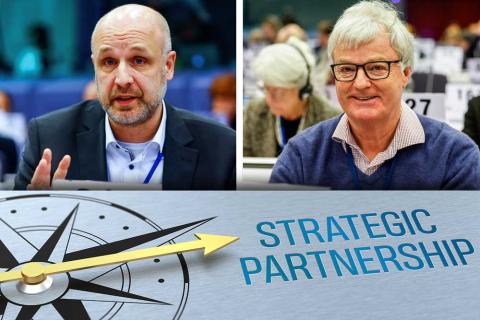
I ett yttrande på eget initiativ om EU:s strategiska kompass konstaterar EESK att det behövs en bredare definition, eftersom det nuvarande säkerhetsbegreppet i EU är för snävt. ”Säkerhet handlar om mer än rent militärt försvar. Då vi står inför komplexa hybridhot bör säkerhetsbegreppet utvidgas till att även omfatta aspekter såsom energi, transporter, digital teknik, vatten- och livsmedelstrygghet, medborgarnas trygghet och utländsk inblandning”, påpekade Christian Moos, föredragande för EESK:s yttrande.
I yttrandet framhålls att EU, utöver nationell kapacitet, försvarsplanering och gemensam upphandling, bör fortsätta att investera sina begränsade resurser främst i civil politik och civila mekanismer för att möjliggöra konfliktförebyggande. Det är här som det civila samhället kan göra skillnad genom sina sociala och ekonomiska nätverk och sin stora potential för offentlig och kulturell diplomati.
Krigets återkomst till Europa i och med Rysslands angrepp mot Ukraina har varit en väckarklocka i fråga om EU:s förbindelser med Nato.
”EU och Nato har ännu inte utforskat den fulla potentialen i sitt samarbete. En förstärkning av den europeiska pelaren för säkerhet och försvar innebär att Nato stärks. När vi talar om att stärka EU:s försvarskapacitet är det inte för att konkurrera med Nato, utan för att komplettera Nato”, sade föredraganden och EESK-ledamoten Peter Clever. (mt)