European Economic
and Social Committee
European Economic
and Social Committee
The European Economic and Social Committee (EESC) is the voice of organised civil society in Europe.
Find out more about its role and structure at http://www.eesc.europa.eu/en/about
The EESC issues between 160 and 190 opinions, evaluation and information reports a year.
It also organises several annual initiatives and events with a focus on civil society and citizens’ participation such as the Civil Society Prize, the Civil Society Days, the Your Europe, Your Say youth plenary and the ECI Day.
Find the latest EESC opinions and publications at http://www.eesc.europa.eu/en/our-work/opinions-information-reports/opinions and http://www.eesc.europa.eu/en/our-work/publications-other-work/publications respectively.
The EESC is active in a wide range of areas, from social affairs to economy, energy and sustainability.
Learn more about our policy areas and policy highlights at http://www.eesc.europa.eu/en/policies
The EESC holds nine plenary sessions per year. It also organises many conferences, public hearings and high-level debates related to its work.
Find out more about our upcoming events at http://www.eesc.europa.eu/en/agenda/our-events/upcoming-events
Here you can find news and information about the EESC'swork, including its social media accounts, the EESC Info newsletter, photo galleries and videos.
Read the latest EESC news http://www.eesc.europa.eu/en/news-media/news and press releases http://www.eesc.europa.eu/en/news-media/press-releases
The EESC brings together representatives from all areas of organised civil society, who give their independent advice on EU policies and legislation. The EESC's326 Members are organised into three groups: Employers, Workers and Various Interests.
Find out more about our Members and groups at http://www.eesc.europa.eu/en/members-groups
The EESC has six sections, specialising in concrete topics of relevance to the citizens of the European Union, ranging from social to economic affairs, energy, environment, external relations or the internal market.
Find out more at http://www.eesc.europa.eu/en/sections-other-bodies
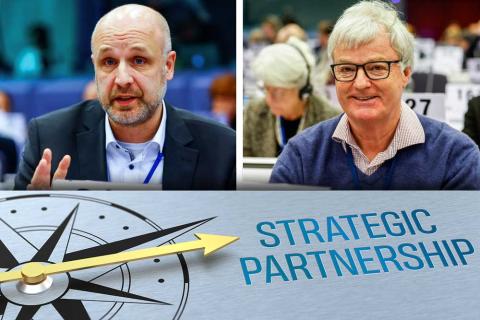
At its January plenary session, the EESC debated the EU's "Strategic Compass" vision for security and defence, arguing that security should be understood broadly, far beyond military defence. Civil society should not be a bystander in security issues: in times of crisis, it can have a stabilising role, as proven by the war in Ukraine.
In an own-initiative opinion on The EU Strategic Compass (SC) the EESC expressed the need for a broader definition, as the present concept of security in the EU is too narrow. "Security goes beyond mere military defence. In times of complex, hybrid threats, the concept of security should be expanded to also include aspects of energy, transport, digital, water and food security, citizens' security, and foreign interference," said Christian Moos, rapporteur for the EESC opinion.
The opinion argues that, in parallel with national capability, defence planning and joint procurement, the EU should continue to invest its limited resources primarily in civilian policies and mechanisms in order to enable conflict prevention. This is where civil society can make a difference, through its social and economic networks, together with its strong potential for public and cultural diplomacy.
The return of war to Europe with Russia's aggression against Ukraine has been a "wake-up call" for the EU's relationship with NATO.
"The EU and NATO have not fully explored the potential of their cooperation yet. Strengthening the European pillar of security and defence means strengthening NATO. When we are talking about boosting the EU's defence capabilities, it is not to compete with NATO but to complement it," said the rapporteur and EESC member Peter Clever. (mt)