European Economic
and Social Committee
European Economic
and Social Committee
The European Economic and Social Committee (EESC) is the voice of organised civil society in Europe.
Find out more about its role and structure at http://www.eesc.europa.eu/en/about
The EESC issues between 160 and 190 opinions, evaluation and information reports a year.
It also organises several annual initiatives and events with a focus on civil society and citizens’ participation such as the Civil Society Prize, the Civil Society Days, the Your Europe, Your Say youth plenary and the ECI Day.
Find the latest EESC opinions and publications at http://www.eesc.europa.eu/en/our-work/opinions-information-reports/opinions and http://www.eesc.europa.eu/en/our-work/publications-other-work/publications respectively.
The EESC is active in a wide range of areas, from social affairs to economy, energy and sustainability.
Learn more about our policy areas and policy highlights at http://www.eesc.europa.eu/en/policies
The EESC holds nine plenary sessions per year. It also organises many conferences, public hearings and high-level debates related to its work.
Find out more about our upcoming events at http://www.eesc.europa.eu/en/agenda/our-events/upcoming-events
Here you can find news and information about the EESC'swork, including its social media accounts, the EESC Info newsletter, photo galleries and videos.
Read the latest EESC news http://www.eesc.europa.eu/en/news-media/news and press releases http://www.eesc.europa.eu/en/news-media/press-releases
The EESC brings together representatives from all areas of organised civil society, who give their independent advice on EU policies and legislation. The EESC's326 Members are organised into three groups: Employers, Workers and Various Interests.
Find out more about our Members and groups at http://www.eesc.europa.eu/en/members-groups
The EESC has six sections, specialising in concrete topics of relevance to the citizens of the European Union, ranging from social to economic affairs, energy, environment, external relations or the internal market.
Find out more at http://www.eesc.europa.eu/en/sections-other-bodies
EESO je na januarskem plenarnem zasedanju razpravljal o viziji strateškega kompasa EU za varnost in obrambo, pri čemer je menil, da bi bilo treba varnost razumeti širše, saj je veliko več kot le vojaška obramba. Civilna družba ne sme biti zgolj opazovalec, ko gre za varnostna vprašanja: v času krize ima lahko vlogo pri stabiliziranju stanja, kar se je pokazalo med vojno v Ukrajini.
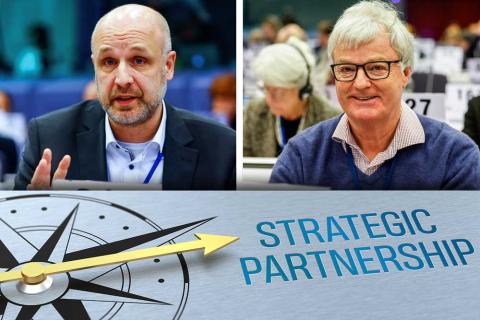
V mnenju na lastno pobudo z naslovom Strateški kompas EU je EESO izrazil potrebo po širši opredelitvi, saj je zdajšnje pojmovanje varnosti v EU preozko. „Varnost presega zgolj vojaško obrambo. V času kompleksnih hibridnih tveganj je treba koncept varnosti razširiti in vanj vključiti tudi vidike energetske in prometne varnosti, digitalne varnosti, varnosti preskrbe z vodo in hrano, državljanske varnosti in tujega vmešavanja“, je dejal Christian Moos, poročevalec za to mnenje EESO.
EESO meni, da bi morala EU poleg razvoja nacionalnih zmogljivosti, obrambnega načrtovanja ter skupnega javnega naročanja, svoja omejena sredstva še naprej vlagati predvsem v civilne politike in mehanizme za preprečevanje konfliktov. Na tem področju lahko civilna družba prispeva s svojimi družbenimi in gospodarskimi mrežami, kakor tudi z velikim potencialom za javno in kulturno diplomacijo.
Ponovna vojna v Evropi, ki jo je povzročil ruski napad na Ukrajino, je bilo svarilo za odnose med EU in NATO.
EU in NATO še nista v celoti izkoristila potenciala svojega sodelovanja. Krepitev evropskega stebra varnosti in obrambe pomeni krepitev zveze NATO. Ko govorimo o krepitvi obrambnih zmogljivosti EU, ne gre za tekmovanje z zvezo NATO, temveč za njeno dopolnjevanje,“ je dejal soporočevalec in član EESO Peter Clever. (mt)