European Economic
and Social Committee
European Economic
and Social Committee
The European Economic and Social Committee (EESC) is the voice of organised civil society in Europe.
Find out more about its role and structure at http://www.eesc.europa.eu/en/about
The EESC issues between 160 and 190 opinions, evaluation and information reports a year.
It also organises several annual initiatives and events with a focus on civil society and citizens’ participation such as the Civil Society Prize, the Civil Society Days, the Your Europe, Your Say youth plenary and the ECI Day.
Find the latest EESC opinions and publications at http://www.eesc.europa.eu/en/our-work/opinions-information-reports/opinions and http://www.eesc.europa.eu/en/our-work/publications-other-work/publications respectively.
The EESC is active in a wide range of areas, from social affairs to economy, energy and sustainability.
Learn more about our policy areas and policy highlights at http://www.eesc.europa.eu/en/policies
The EESC holds nine plenary sessions per year. It also organises many conferences, public hearings and high-level debates related to its work.
Find out more about our upcoming events at http://www.eesc.europa.eu/en/agenda/our-events/upcoming-events
Here you can find news and information about the EESC'swork, including its social media accounts, the EESC Info newsletter, photo galleries and videos.
Read the latest EESC news http://www.eesc.europa.eu/en/news-media/news and press releases http://www.eesc.europa.eu/en/news-media/press-releases
The EESC brings together representatives from all areas of organised civil society, who give their independent advice on EU policies and legislation. The EESC's326 Members are organised into three groups: Employers, Workers and Various Interests.
Find out more about our Members and groups at http://www.eesc.europa.eu/en/members-groups
The EESC has six sections, specialising in concrete topics of relevance to the citizens of the European Union, ranging from social to economic affairs, energy, environment, external relations or the internal market.
Find out more at http://www.eesc.europa.eu/en/sections-other-bodies
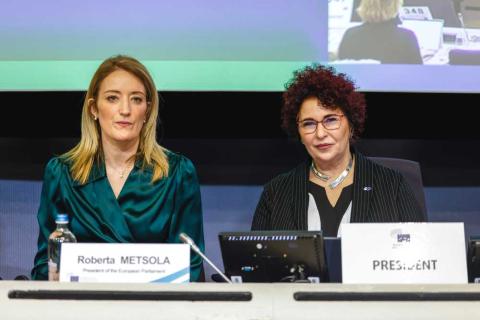
Vid EESK:s plenarsession i januari diskuterade EESK:s ledamöter och Europaparlamentets talman Roberta Metsola EU:s hantering av geopolitiska utmaningar. Hon höll med EESK:s ordförande Christa Schweng om att konkurrenskraft, jämte strategiskt oberoende, är avgörande i dagens svåra situation.
Roberta Metsola hyllade det ukrainska folket för deras mod och motstånd mot den ryska invasionen och betonade att EU har gått samman som aldrig förr för att tillhandahålla ekonomiskt, humanitärt och militärt bistånd till Ukraina. ”Ukraina kämpar för demokrati, fred och rättvisa, och kämpar även å våra vägnar”, förklarade hon.
Med anledning av den inre marknadens 30-års jubileum pekade Roberta Metsola på betydelsen av konkurrenskraft. ”Vi måste återgå till tillväxt och minska vårt beroende, samtidigt som vi kraftfullt driver på den gröna och den digitala omställningen. EU måste dra nytta av sina styrkor och bedriva en aktiv handelspolitik som ger fördelar för EU:s medborgare varje dag”.
EESK:s ordförande Christa Schweng, menade att dessa aspekter är väsentliga för invånarnas och företagens välstånd i hela EU. ”Det må bära eller brista i detta läge. Endast genom samordnade insatser kommer vi att kunna bygga en mer resilient, rättvis och hållbar framtid där ingen lämnas på efterkälken”.
Andra frågor som diskuterades var EU:s hantering av externa ekonomiska faktorer såsom den amerikanska lagen om minskning av inflationen, Rysslands aggressionskrig mot Ukraina och volatiliteten i bränslepriserna samt aktuella interna utmaningar såsom bristen på utbildad arbetskraft i Europa.
Under debatten underströks det att det civila samhället har en viktig roll att spela när det handlar om att förbättra EU:s politiska åtgärder och hur de genomförs, samt att EU:s medborgare vill ha mer att säga till om i EU, vilket framkom under konferensen om Europas framtid. (mt)