European Economic
and Social Committee
European Economic
and Social Committee
The European Economic and Social Committee (EESC) is the voice of organised civil society in Europe.
Find out more about its role and structure at http://www.eesc.europa.eu/en/about
The EESC issues between 160 and 190 opinions, evaluation and information reports a year.
It also organises several annual initiatives and events with a focus on civil society and citizens’ participation such as the Civil Society Prize, the Civil Society Days, the Your Europe, Your Say youth plenary and the ECI Day.
Find the latest EESC opinions and publications at http://www.eesc.europa.eu/en/our-work/opinions-information-reports/opinions and http://www.eesc.europa.eu/en/our-work/publications-other-work/publications respectively.
The EESC is active in a wide range of areas, from social affairs to economy, energy and sustainability.
Learn more about our policy areas and policy highlights at http://www.eesc.europa.eu/en/policies
The EESC holds nine plenary sessions per year. It also organises many conferences, public hearings and high-level debates related to its work.
Find out more about our upcoming events at http://www.eesc.europa.eu/en/agenda/our-events/upcoming-events
Here you can find news and information about the EESC'swork, including its social media accounts, the EESC Info newsletter, photo galleries and videos.
Read the latest EESC news http://www.eesc.europa.eu/en/news-media/news and press releases http://www.eesc.europa.eu/en/news-media/press-releases
The EESC brings together representatives from all areas of organised civil society, who give their independent advice on EU policies and legislation. The EESC's326 Members are organised into three groups: Employers, Workers and Various Interests.
Find out more about our Members and groups at http://www.eesc.europa.eu/en/members-groups
The EESC has six sections, specialising in concrete topics of relevance to the citizens of the European Union, ranging from social to economic affairs, energy, environment, external relations or the internal market.
Find out more at http://www.eesc.europa.eu/en/sections-other-bodies
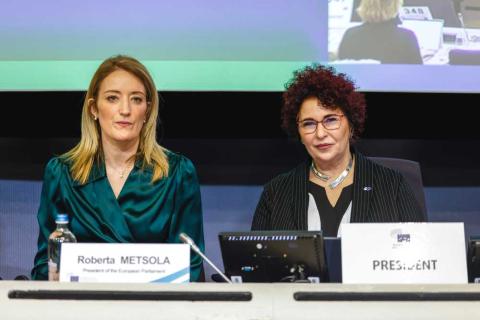
Na plenarnom zasjedanju Europskog gospodarskog i socijalnog odbora (EGSO) u siječnju njegovi su članovi i članice održali raspravu s Robertom Metsolom, predsjednicom Europskog parlamenta, o odgovoru EU-a na geopolitičke izazove. Ona se složila s predsjednicom EGSO-a Christom Schweng da su konkurentnost i veća strateška autonomija u ovim teškim vremenima ključne.
Roberta Metsola odala je počast ukrajinskom narodu na njegovu hrabrom otporu ruskoj agresiji i istaknula da je Europska unija pokazala dosad neviđeno jedinstvo u pružanju financijske, humanitarne i vojne pomoći Ukrajini. „Ukrajina se bori za demokraciju, slobodu i pravdu, a pritom se bori i za nas”, rekla je.
Osvrnuvši se na 30. godišnjicu jedinstvenog tržišta, naglasila je važnost konkurentnosti: „Moramo ponovno ostvarivati rast i smanjiti našu ovisnost, a istodobno udvostručiti napore u području zelene i digitalne tranzicije. Europa bi trebala iskoristiti svoje prednosti i pobrinuti se da naša aktivna trgovinska politika doprinosi svakodnevnom boljitku Europljana.”
Predsjednica EGSO-a Christa Schweng smatra da su ti aspekti ključni za prosperitet ljudi i poduzeća u EU-u: „Nalazimo se u prijelomnom trenutku i samo koordiniranim djelovanjem možemo uspješno izgraditi otporniju, pravedniju i održiviju budućnost u kojoj nitko neće biti zapostavljen.”
U raspravi je bilo riječi i o odgovoru EU-a na vanjske ekonomske faktore, kao što su američki Zakon o smanjenju inflacije, ruska agresija na Ukrajinu i volatilnost cijena fosilnih goriva, te o unutarnjim izazovima poput nedostatka kvalificirane radne snage s kojim se Europa trenutno suočava.
Istaknuto je i da civilno društvo ima ključnu ulogu u poboljšanju politika EU-a i načinu njihove provedbe te da europski građani žele više sudjelovati u donošenju odluka u Uniji, na što je ukazala Konferencija o budućnosti Europe. (mt)