
European Economic
and Social Committee
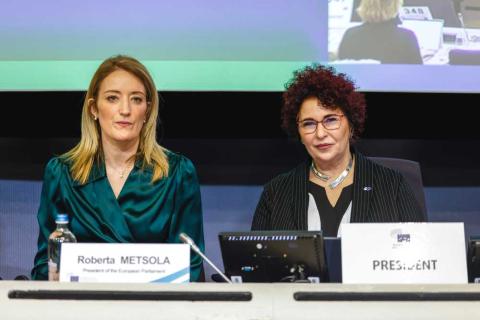
At the EESC's January plenary session, EESC members discussed the EU's response to geopolitical challenges with Roberta Metsola, President of the European Parliament. She agreed with EESC President Christa Schweng that competitiveness, together with strategic autonomy, is crucial in the current challenging times.
Ms Metsola paid tribute to the Ukrainian people for their brave resistance to the Russian aggression and stressed that the European Union had rallied together like never before to provide Ukraine with financial, humanitarian and military assistance. She said: "Ukraine is fighting for democracy, freedom and justice. And fighting for us too".
Referring to the 30th anniversary of the single market, she emphasised the importance of competitiveness: "We must return to growth and lower our dependencies, while doubling-down on the green and digital transitions. Europe should play to its strengths and make sure our active trade policy brings benefits to Europeans every day".
For EESC President Christa Schweng, these aspects are essential for the prosperity of people and businesses in the EU: "It's a make-or-break moment, and only through coordinated efforts can we successfully build a more resilient, fair and sustainable future in which nobody is left behind".
The discussion also touched on the EU's response to external economic factors such as the American Inflation Reduction Act, Russia's war of aggression against Ukraine, and the volatility of fossil fuel prices, and internal challenges such as the lack of a skilled workforce that Europe is currently experiencing.
The debate highlighted that civil society has a critical role to play in improving EU policies and the way they are implemented, and that Europeans want a bigger say in the EU, a point proven during the Conference on the Future of Europe. (mt)