European Economic
and Social Committee
European Economic
and Social Committee
The European Economic and Social Committee (EESC) is the voice of organised civil society in Europe.
Find out more about its role and structure at http://www.eesc.europa.eu/en/about
The EESC issues between 160 and 190 opinions, evaluation and information reports a year.
It also organises several annual initiatives and events with a focus on civil society and citizens’ participation such as the Civil Society Prize, the Civil Society Days, the Your Europe, Your Say youth plenary and the ECI Day.
Find the latest EESC opinions and publications at http://www.eesc.europa.eu/en/our-work/opinions-information-reports/opinions and http://www.eesc.europa.eu/en/our-work/publications-other-work/publications respectively.
The EESC is active in a wide range of areas, from social affairs to economy, energy and sustainability.
Learn more about our policy areas and policy highlights at http://www.eesc.europa.eu/en/policies
The EESC holds nine plenary sessions per year. It also organises many conferences, public hearings and high-level debates related to its work.
Find out more about our upcoming events at http://www.eesc.europa.eu/en/agenda/our-events/upcoming-events
Here you can find news and information about the EESC'swork, including its social media accounts, the EESC Info newsletter, photo galleries and videos.
Read the latest EESC news http://www.eesc.europa.eu/en/news-media/news and press releases http://www.eesc.europa.eu/en/news-media/press-releases
The EESC brings together representatives from all areas of organised civil society, who give their independent advice on EU policies and legislation. The EESC's326 Members are organised into three groups: Employers, Workers and Various Interests.
Find out more about our Members and groups at http://www.eesc.europa.eu/en/members-groups
The EESC has six sections, specialising in concrete topics of relevance to the citizens of the European Union, ranging from social to economic affairs, energy, environment, external relations or the internal market.
Find out more at http://www.eesc.europa.eu/en/sections-other-bodies
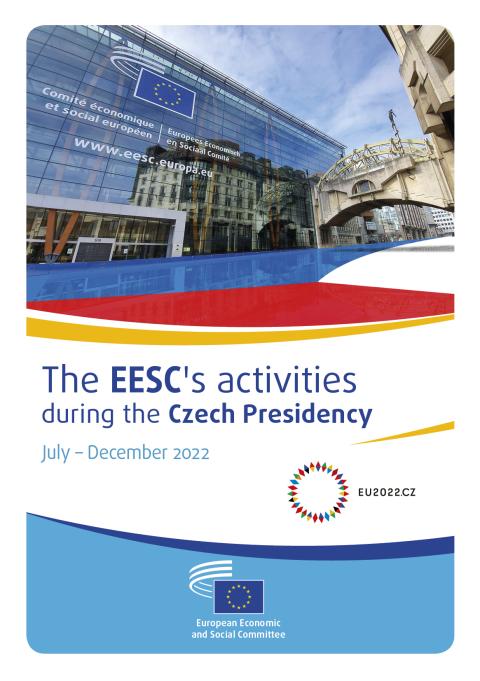
I en nyligen utgiven broschyr beskrivs hur EESK planerar att bidra till att det nya tjeckiska ordförandeskapets mål uppnås.
Det tjeckiska ordförandeskapet för Europeiska unionens råd kommer att behöva hantera inte bara den humanitära krisen till följd av kriget i Ukraina, utan även de fortsatta ekonomiska konsekvenserna av kriget. Att Europa ännu inte helt har återhämtat sig från den kris som orsakats av covid-19-pandemin gör utmaningen ännu större.
Det nya ordförandeskapet har för avsikt att inrikta sina insatser på att säkerställa energitrygghet, utveckla EU-ekonomins strategiska resiliens samt stärka försvarskapaciteten och cybersäkerheten i Europa. Samtidigt kommer ordförandeskapet att behöva ta itu med frågor som rör hanteringen av flyktingkrisen och Ukrainas återhämtning.
Rättsstatsprincipen och de demokratiska institutionernas resiliens kommer också att stå i centrum för det nya ordförandeskapets prioriteringar.
Det tjeckiska ordförandeskapet kommer också att ha en annan viktig roll att spela när det gäller att säkerställa en lämplig, öppen och omfattande uppföljning av konferensen om Europas framtid.
Kommittén är fast besluten att ha ett nära samarbete med det tjeckiska ordförandeskapet om dessa gemensamma mål. I en nyligen utgiven broschyr beskrivs hur var och en av EESK:s tematiska sektioner planerar att bidra inom sina politikområden. I broschyren belyses också de frågor där det tjeckiska ordförandeskapet specifikt har bett EESK att tillhandahålla sin sakkunskap. Kommittén kommer att göra allt för att se till att Europas civilsamhällesorganisationer kan göra sina röster hörda under hela ordförandeskapet.
Broschyren finns tillgänglig på engelska, franska, tyska och tjeckiska på EESK:s webbplats. Tryckta exemplar kan beställas från vipcese@eesc.europa.eu. (fgr)