European Economic
and Social Committee
European Economic
and Social Committee
The European Economic and Social Committee (EESC) is the voice of organised civil society in Europe.
Find out more about its role and structure at http://www.eesc.europa.eu/en/about
The EESC issues between 160 and 190 opinions, evaluation and information reports a year.
It also organises several annual initiatives and events with a focus on civil society and citizens’ participation such as the Civil Society Prize, the Civil Society Days, the Your Europe, Your Say youth plenary and the ECI Day.
Find the latest EESC opinions and publications at http://www.eesc.europa.eu/en/our-work/opinions-information-reports/opinions and http://www.eesc.europa.eu/en/our-work/publications-other-work/publications respectively.
The EESC is active in a wide range of areas, from social affairs to economy, energy and sustainability.
Learn more about our policy areas and policy highlights at http://www.eesc.europa.eu/en/policies
The EESC holds nine plenary sessions per year. It also organises many conferences, public hearings and high-level debates related to its work.
Find out more about our upcoming events at http://www.eesc.europa.eu/en/agenda/our-events/upcoming-events
Here you can find news and information about the EESC'swork, including its social media accounts, the EESC Info newsletter, photo galleries and videos.
Read the latest EESC news http://www.eesc.europa.eu/en/news-media/news and press releases http://www.eesc.europa.eu/en/news-media/press-releases
The EESC brings together representatives from all areas of organised civil society, who give their independent advice on EU policies and legislation. The EESC's326 Members are organised into three groups: Employers, Workers and Various Interests.
Find out more about our Members and groups at http://www.eesc.europa.eu/en/members-groups
The EESC has six sections, specialising in concrete topics of relevance to the citizens of the European Union, ranging from social to economic affairs, energy, environment, external relations or the internal market.
Find out more at http://www.eesc.europa.eu/en/sections-other-bodies
EESO v novi brošuri predstavlja, kako namerava pomagati pri doseganju ciljev češkega predsedstva
Češko predsedstvo Sveta Evropske unije bo moralo obvladovati ne samo humanitarno krizo, ki jo je povzročila vojna v Ukrajini, ampak tudi nadaljnje gospodarske posledice tega konflikta. Ta izziv je še toliko večji zaradi dejstva, da si Evropa še ni v celoti opomogla od krize, ki jo je povzročila pandemija COVID-19.
Češko predsedstvo namerava svoja prizadevanja osredotočiti na zagotavljanje energetske varnosti, razvoj strateške odpornosti gospodarstva EU in okrepitev obrambnih zmogljivosti in kibernetske varnosti v Evropi. Hkrati bo moralo obravnavati vprašanja, povezana z upravljanjem begunske krize in okrevanjem Ukrajine.
Med prednostnimi nalogami predsedstva bo tudi pravna država in odpornost demokratičnih institucij.
Češko predsedstvo bo imelo še eno pomembno vlogo, in sicer pri zagotavljanju ustreznega, preglednega in obsežnega nadaljnjega ukrepanja po Konferenci o prihodnosti Evrope.
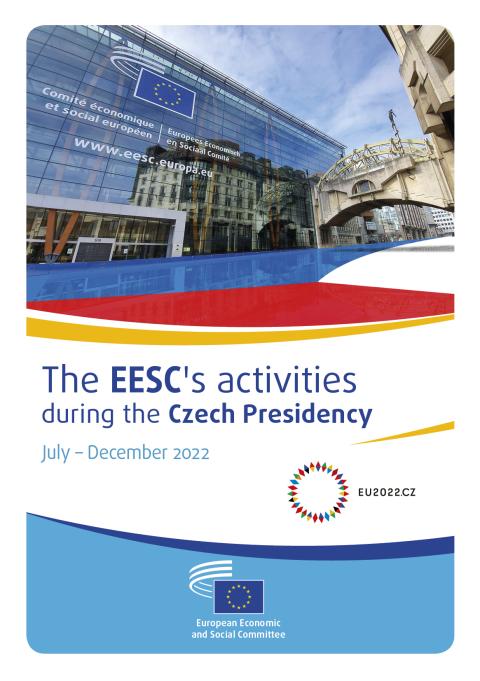
EESO je odločen, da bo pri teh skupnih ciljih tesno sodeloval s češkim predsedstvom. V novi brošuri je podrobno opisano, kako namerava vsaka od tematskih strokovnih skupin EESO prispevati na svojih političnih področjih, poudarjena pa so vprašanja, pri katerih je češko predsedstvo posebej zaprosilo za strokovno znanje EESO. Odbor si bo močno prizadeval za to, da se bo med predsedovanjem slišal glas organizacij evropske civilne družbe.
Brošura je na voljo v angleščini, francoščini, nemščini in češčini na spletišču EESO. V tiskani obliki jo lahko naročite tu: vipcese@eesc.europa.eu. (fgr)