European Economic
and Social Committee
European Economic
and Social Committee
The European Economic and Social Committee (EESC) is the voice of organised civil society in Europe.
Find out more about its role and structure at http://www.eesc.europa.eu/en/about
The EESC issues between 160 and 190 opinions, evaluation and information reports a year.
It also organises several annual initiatives and events with a focus on civil society and citizens’ participation such as the Civil Society Prize, the Civil Society Days, the Your Europe, Your Say youth plenary and the ECI Day.
Find the latest EESC opinions and publications at http://www.eesc.europa.eu/en/our-work/opinions-information-reports/opinions and http://www.eesc.europa.eu/en/our-work/publications-other-work/publications respectively.
The EESC is active in a wide range of areas, from social affairs to economy, energy and sustainability.
Learn more about our policy areas and policy highlights at http://www.eesc.europa.eu/en/policies
The EESC holds nine plenary sessions per year. It also organises many conferences, public hearings and high-level debates related to its work.
Find out more about our upcoming events at http://www.eesc.europa.eu/en/agenda/our-events/upcoming-events
Here you can find news and information about the EESC'swork, including its social media accounts, the EESC Info newsletter, photo galleries and videos.
Read the latest EESC news http://www.eesc.europa.eu/en/news-media/news and press releases http://www.eesc.europa.eu/en/news-media/press-releases
The EESC brings together representatives from all areas of organised civil society, who give their independent advice on EU policies and legislation. The EESC's326 Members are organised into three groups: Employers, Workers and Various Interests.
Find out more about our Members and groups at http://www.eesc.europa.eu/en/members-groups
The EESC has six sections, specialising in concrete topics of relevance to the citizens of the European Union, ranging from social to economic affairs, energy, environment, external relations or the internal market.
Find out more at http://www.eesc.europa.eu/en/sections-other-bodies
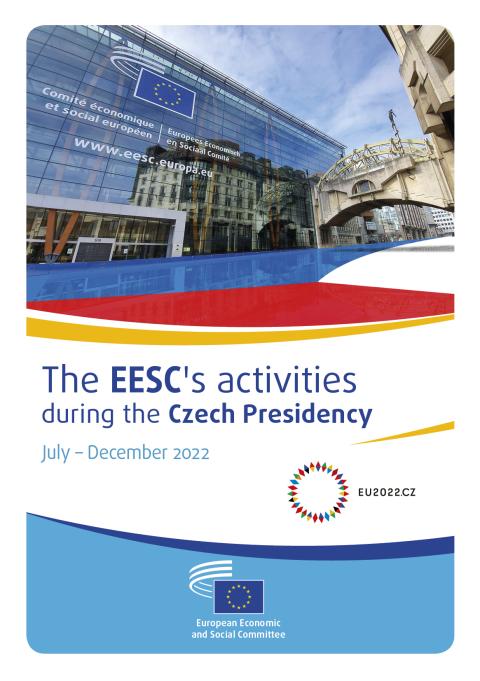
A newly published brochure sets out how the EESC intends to help achieve the objectives of the Czech presidency.
The Czech presidency of the Council of the European Union will have to deal not only with the humanitarian crisis caused by the war in Ukraine, but also with the continuing economic consequences of the conflict. The fact that Europe has not yet fully recovered from the crisis caused by the COVID-19 pandemic only makes the challenge greater.
The incoming presidency intends to focus its efforts on ensuring energy security, developing the EU economy's strategic resilience and boosting defence capabilities and cybersecurity in Europe. At the same time, it will have to deal with issues relating to management of the refugee crisis and Ukraine's recovery.
The rule of law and the resilience of democratic institutions will also be at the heart of the incoming presidency's priorities.
The Czech presidency will also have another important role to play in ensuring an appropriate, transparent and substantial follow-up to the Conference on the Future of Europe.
The EESC is determined to work closely with the Czech presidency on these joint objectives. A newly published brochure details the way in which each one of the EESC's thematic sections is planning to contribute in its policy areas. The brochure also highlights the issues on which the Czech presidency has specifically asked the EESC to provide its expertise. The Committee will make every effort to ensure that the voices of Europe's civil society organisations are heard throughout the presidency.
The brochure is available in English, French, German and Czech on the EESC's website. Hard copies may be ordered from: vipcese@eesc.europa.eu. (fgr)