European Economic
and Social Committee
European Economic
and Social Committee
The European Economic and Social Committee (EESC) is the voice of organised civil society in Europe.
Find out more about its role and structure at http://www.eesc.europa.eu/en/about
The EESC issues between 160 and 190 opinions, evaluation and information reports a year.
It also organises several annual initiatives and events with a focus on civil society and citizens’ participation such as the Civil Society Prize, the Civil Society Days, the Your Europe, Your Say youth plenary and the ECI Day.
Find the latest EESC opinions and publications at http://www.eesc.europa.eu/en/our-work/opinions-information-reports/opinions and http://www.eesc.europa.eu/en/our-work/publications-other-work/publications respectively.
The EESC is active in a wide range of areas, from social affairs to economy, energy and sustainability.
Learn more about our policy areas and policy highlights at http://www.eesc.europa.eu/en/policies
The EESC holds nine plenary sessions per year. It also organises many conferences, public hearings and high-level debates related to its work.
Find out more about our upcoming events at http://www.eesc.europa.eu/en/agenda/our-events/upcoming-events
Here you can find news and information about the EESC'swork, including its social media accounts, the EESC Info newsletter, photo galleries and videos.
Read the latest EESC news http://www.eesc.europa.eu/en/news-media/news and press releases http://www.eesc.europa.eu/en/news-media/press-releases
The EESC brings together representatives from all areas of organised civil society, who give their independent advice on EU policies and legislation. The EESC's326 Members are organised into three groups: Employers, Workers and Various Interests.
Find out more about our Members and groups at http://www.eesc.europa.eu/en/members-groups
The EESC has six sections, specialising in concrete topics of relevance to the citizens of the European Union, ranging from social to economic affairs, energy, environment, external relations or the internal market.
Find out more at http://www.eesc.europa.eu/en/sections-other-bodies
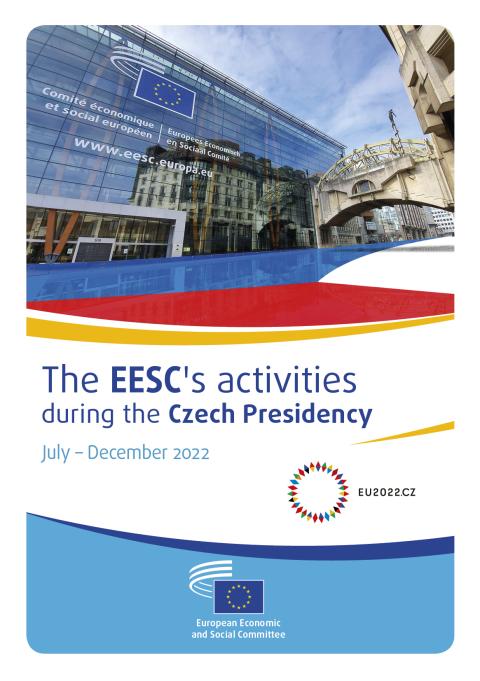
In een onlangs gepubliceerde brochure zet het EESC uiteen hoe het de doelstellingen van het Tsjechische voorzitterschap wil helpen verwezenlijken.
Het Tsjechische voorzitterschap van de Raad van de Europese Unie zal niet alleen het hoofd moeten bieden aan de humanitaire crisis als gevolg van de oorlog in Oekraïne, maar ook aan de aanhoudende economische gevolgen van het conflict. Dat is een aanzienlijke uitdaging, temeer daar Europa nog niet helemaal hersteld is van de COVID-19-pandemie.
Het voorzitterschap wil zijn aandacht richten op energiezekerheid, de ontwikkeling van de strategische veerkracht van de EU-economie en het versterken van defensie en cyberveiligheid in Europa. Tegelijkertijd zal het zich moeten bezighouden met het beheer van de vluchtelingencrisis en het herstel van Oekraïne.
Ook de rechtsstaat en de veerkracht van de democratische instellingen staan hoog op de agenda van het Tsjechische voorzitterschap.
Daarnaast zal het voorzitterschap nog een andere belangrijke rol spelen: het wil gepast, transparant en tastbaar gevolg geven aan de Conferentie over de toekomst van Europa.
Het EESC is vastberaden om nauw met het Tsjechische voorzitterschap samen te werken aan die gemeenschappelijke doelstellingen. In een onlangs gepubliceerde brochure wordt nader toegelicht hoe de thematische afdelingen van het EESC elk van plan zijn bij te dragen aan de beleidsterreinen. In de brochure komen ook onderwerpen naar voren waarover het Tsjechische voorzitterschap specifiek om de expertise van het EESC heeft gevraagd. Het Comité zal alles in het werk stellen om tijdens het voorzitterschap als spreekbuis van het Europees maatschappelijk middenveld op te treden.
De brochure is op de website van het EESC beschikbaar in het Engels, Frans, Duits en Tsjechisch. Gedrukte exemplaren kunnen worden aangevraagd op het volgende adres: vipcese@eesc.europa.eu. (fgr)