
European Economic
and Social Committee
Building a Resilient Future: Civil Society Week 2026 Kicks Off
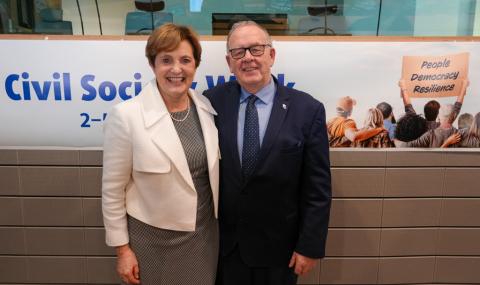
The European Economic and Social Committee (EESC) has launched the 2026 edition of Civil Society Week under the theme ‘People, Democracy, Resilience – Our Future’. From 2 to 5 March, the event will bring together more than 1 300 participants, including youth organisations, activists, organised civil society representatives from across Europe, journalists and EU policymakers. Discussions will focus on tackling poverty, combating social exclusion, fostering civic engagement and bridging divides between regions and between generations to rebuild trust and strengthen social cohesion.
This is the third edition of Civil Society Week, which is being held by the EESC and will act as a catalyst for greater civil society participation. During Civil Society Week, 36 civil society organisations and more than 90 speakers will be present, turning the event into a dynamic forum where participants meet to network, reflect and exchange ideas on issues that directly affect people’s everyday lives.
In the opening session, EESC President Séamus Boland and former Irish Minister for Children and Youth Affairs Dr Katherine Zappone underlined that the three pillars of the theme were the foundations for opportunities, security and resilience across the EU. Over the next four days, the sessions will unpack these pillars, link them to the EU’s priorities and set out what contribution civil society can make.
‘Civil Society Week is not a symbolic event, it is a practical example of why EU institutions, social partners and civil society organisations need to work together. Organised civil society is not a luxury, it is a core piece of democratic infrastructure. Without it, democracy does not merely struggle – it stops working properly,’ said Mr Boland. ‘A resilient and united Europe does not improve on autopilot. It improves because people organise.’
Referring to the recent concerning events in the Middle East, Mr Boland called for international law to be fully respected and, in particular, for civilians to be protected. He also underlined the importance of dialogue and civil society participation in ending conflicts and advancing democracy.
Dr Zappone stressed that freedom and democracy were absolute priorities for the European Union. She explained that it took concerted action to create systems enabling both younger and older people to be free. ‘We are all aware that, for both younger and older people to be free, it is important that the conditions we live in and the relationships we have respect our dignity and ensure equality,’ she added.
On 3 March, the European Citizens’ Initiative event will take place. Recent developments have highlighted its growing potential as, in the space of only a few months, four initiatives have exceeded one million signatures. This surge in support demonstrates Europeans’ increasing readiness to actively engage and help shape the EU agenda.
On 4 March a panel discussion will put the spotlight on the European Democracy Shield, specifically on how citizen participation can be meaningfully embedded in it. The agenda also includes a media and digital resilience session and a discussion on whether social media and AI algorithms can ensure the right to accurate information and the visibility of high-quality content across Europe.
On 5 March the closing session will be held, with recommendations and conclusions which will feed into the EESC’s opinions and will be presented at the plenary session on 18 March.
- Follow Civil Society Week here: Webstream link
- The programme is available here.
- #CivSocWeek
Work organisation
Downloads
-
Building a Resilient Future: Civil Society Week 2026 Kicks Off