
European Economic
and Social Committee
Our new EESC web section highlights trends in the area of fundamental rights and the rule of law in the EU
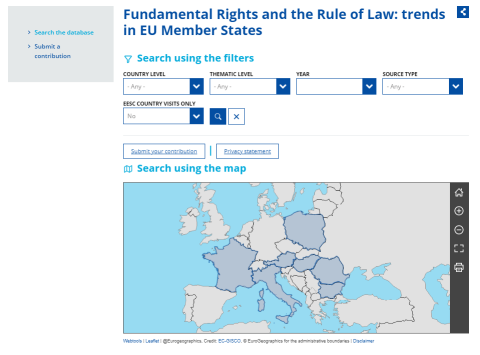
Today, the EESC has launched a new web section entitled Fundamental Rights and the Rule of Law: trends in EU Member States
. This will allow readers to consult in a more focused way than previously the information that the EESC Fundamental Rights and Rule of Law (FRRL) Group has received from stakeholders as part of its country visits.
Since it was set up in 2018, the EESC FRRL Group has visited nine countries, and intends to visit all 27 EU Member States. Country visits offer the opportunity for a delegation of EESC members to listen to the views of civil society – including business representatives, trade unionists, media and legal professionals, civil society organisations – on national developments concerning fundamental rights and the rule of law. Visits also include exchanges with the country's European Commission Representation and with national authorities.
The results of the country visits are published in reports that aim to faithfully reflect the views of civil society. These reports, as well as all the information on the new web section, do not represent the views of the EESC. With this initiative, the EESC wants to encourage open and inclusive dialogue, and thus always invites national authorities to submit their observations, which are published along with the country visit report, and are also published in this new web section.
Until now, the information gathered by the FRRL Group has been published in the form of a synthesis report. The new web section will allow readers to find more specific information, by filtering the available data by theme, country, date, and type. The web section currently features information received from stakeholders in the preparation for or follow-up to country visits as well as observations by national authorities. Stakeholders will soon be able to propose to publish their contribution to the European Commission's annual report on the rule of law.
On the occasion of the launch of the web section, the EESC is publishing the country report and authorities' observations on the FRRL Group virtual visit to Denmark, which took place on 21-22 December 2020.
Background
The FRRL Group was created in 2018 as a horizontal body within the European Economic and Social Committee, and was tasked with enhancing the contribution of organised civil society to strengthening fundamental rights, democracy and the rule of law and responding to the shrinking civic space for civil society organisations. Its work is structured around an approach that covers areas that are considered particularly important and relevant to the work of the EESC: freedom of association, freedom of assembly, freedom of expression and freedom of the media, discrimination, and the rule of law as the guarantor of fundamental rights as they relate to all civil society organisations, including social partners.
Work organisation
Recommended for you
YEYS! 2023: Mládež žiada transparentnejšiu, digitálnejšiu a jednoduchšiu EÚ
News
Európsky hospodársky a sociálny výbor (EHSV) usporiadal 23. a 24. marca 14. ročník podujatia Vaša Európa, váš názor (YEYS), ktoré priviedlo do Bruselu 105…
Slovenská organizácia Integra získava Cenu EHSV pre občiansku spoločnosť za boj proti stereotypom spájaným s duševnými poruchami
News
Európsky hospodársky a sociálny výbor (EHSV) sa tohto roku rozhodol udeliť Cenu pre občiansku spoločnosť projektom na podporu duševného zdravia. Víťazom sa stala írska charitatívna organizácia…
EHSV otvára nový ročník Ceny pre občiansku spoločnosť, ktorej ústrednou témou je duševné zdravie
News
Organizácie občianskej spoločnosti, jednotlivci a súkromné spoločnosti môžu odteraz predkladať svoje neziskové projekty a uchádzať sa o cenu EHSV venovanú podpore duševnej pohody…
Odovzdajte svoj hlas v európskych voľbách v júni 2024: EHSV vyzýva Európanov, aby hlasovali za zjednotenú a demokratickú Európu
News
Vzhľadom na celosvetový trend ústupu demokracie, rýchle šírenie dezinformácií a zvyšujúcu sa nespokojnosť v dôsledku nárastu inflácie a hrozby vojny, pôjde pri hlasovaní o novom…
Dezinformácie a nedostatok záujmu sú hlavnými príčinami vysokej neúčasti voličov vo voľbách do Európskeho parlamentu
News
Európania musia poznať konkrétny vplyv rozhodnutí EÚ na ich životy, čo ich pomôže mobilizovať sa k účasti na voľbách. Rôznym krajinám EÚ je potrebné prispôsobiť rôzne posolstvá. Je potrebné preto…