
European Economic
and Social Committee
EESC PLENARY: Full support to My Voice, My Choice citizens’ initiative
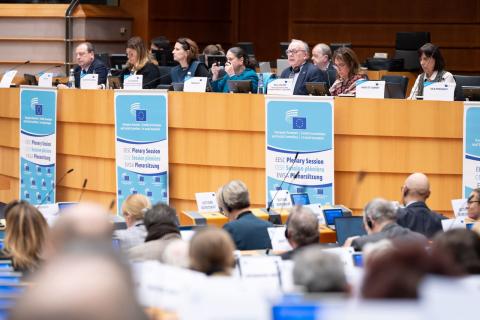
At its January plenary session, the European Economic and Social Committee (EESC) debated the European Citizens’ Initiative My Voice, My Choice: For Safe and Accessible Abortion, linked to the presentation and adoption of its opinion on the same ECI SOC/848. The opinion endorsed the ECI’s proposal for an EU solidarity mechanism enabling women who cannot access abortion in their home country to obtain care in another Member State. Following a debate, the opinion was adopted with broad support, underscoring the Committee’s commitment to protecting women’s bodily autonomy and ensuring equal access to reproductive healthcare across the EU.
The debate was joined by Nika Kovač, representative of the ECI, Irena Moozová, Deputy Director General of the European Commission’s Directorate-General JUST, Abir Al-Sahlani, Member of the European Parliament's Committee on Women's Rights and Gender Equality, and Mary Collins, Secretary-General of the European Women’s Lobby.
Ensuring that rights and services are not only guaranteed in principle, but accessible in practice, lies at the heart of social justice and political responsibility. This is precisely where civil society plays a vital role,
said EESC President Séamus Boland. This debate offers an important opportunity to reflect on the role of the EU, its institutions and civil society in addressing complex and sensitive societal challenges.
Members of the Civil Society Organisations’ Group underlined the human rights, social, and equality dimensions of abortion access, stressing that legal recognition must translate into real, universal access across the EU.
Group Vice-President Lidija Pavić-Rogošić emphasised that: This European Citizens’ Initiative is not only a call for safe abortion; it is a call for a fundamental right – the right of every person to make decisions about their own body. We cannot have a true democracy if half the population is denied essential health services and forced into unequal health conditions. Women’s rights must be harmonised across Europe, and those rights must not depend on one’s address.
Group Vice-President Juliane Marie Neiiendam expressed strong support for access to safe and legal abortion. When access to abortion depends on where you live, equality fails. This is about dignity, equality, and justice. Europe must guarantee genuine access, not just rights on paper. It is time for political courage.
Laura Albu told the plenary session about the situation in Romania. We face a crisis affecting girls. We account for 45% of all EU births to girls under the age of 15. Poverty traps them as the state fails to protect. Some 85% of young mothers leave school early, undermining their future economic capacity and dignity. We must give young girls in Romania – and across Europe – a future, dignity, and real choices.
Ewa Kulik-Bielińska thanked the rapporteurs and the speakers on behalf of civil society and the thousands of women who are fighting for equal abortion rights. This initiative is about solidarity among women and about upholding the human rights that the European Union is meant to promote.
Corina Murafa Benga concluded by stressing the need for de facto, not only de jure, access: This initiative reminds us that the right to abortion must exist not only in legislation but also in practice. Effective access to abortion is a basic safeguard against inhumane treatment and a cornerstone of women’s dignity and autonomy.
Read the EESC’s press release: https://www.eesc.europa.eu/en/news-media/press-releases/eesc-gives-full-support-my-voice-my-choice-initiative
Watch the debate at: https://www.europarl.europa.eu/streaming/?event=20260121-1430-SPECIAL-OTHER