
European Economic
and Social Committee
EESC Employers' Group delegation at the Delphi Economic Forum 2025
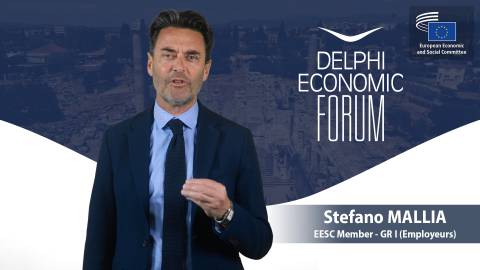
From 9 to 12 April 2025, an EESC Employers' Group delegation participated in the Delphi Economic Forum in Greece, becoming an institutional partner of this distinguished event that brings together leaders from politics, business, academia, and civil society to discuss and shape the policies for the future of Europe and the world, including related to competitiveness, geopolitics, sustainability and global trade.
Speaking at the panel "From Letta to Draghi: Two Reports, One Clear Path for the Future of European Competitiveness", EESC Employers' Group Vice-President Winand Quaedvlieg underlined that the evolving geopolitical landscape has significantly changed since the two reports, particularly in showing that our closest partner, the current US administration, has become very unpredictable.
Mr Quaedvlieg highlighted that Europe cannot rely anymore on external energy sources, defence, and technology, and that a competitive Europe means a strong Europe - one that can defend its strategic interests, maintain social cohesion, and uphold the values that define our Union.
In this context, initiatives laid out by the EU Commission, such as the Clean Industrial Deal, the Affordable Energy Action Plan, and the first Omnibus Simplification Package, are positive steps that show real intent, but strategy alone isn’t enough. Talk in Brussels hasn’t yet translated into relief for businesses on the ground. Overregulation, high energy costs, and labour shortages remain the top barriers to growth.
This is why simplification is the no.1 priority. Today, more than 60% of businesses cite regulation as a major barrier to investment. The complexity and volume of EU regulation have become unsustainable, especially for SMEs. Businesses are forced to divert resources toward compliance, hire external consultants, and pause innovation. Simplification is the most powerful lever to make Europe more attractive for innovators and startups.
As our Spanish memberAntonio García Del Riego further stressed, internal barriers in terms of VAT and consumer protection regulations are equivalent to tariffs as high as 45% for goods and up to 110% for services, according to the Draghi report. A 2,4% increase in intra-trade would offset a 20% decrease in exports to the USA.
EESC External Relations Section President Dimitris Dimitriadis underlined, at the panel titled "The Great Economic Mindshift: What it Means for Global Trade", that the 20% tariffs announced by the US is unjustified and disproportionate, but trade is not a zero-sum game. On the contrary, open and fair trade is a critical driver for innovation, development, and growth. Hence, we must actively promote dialogue and cooperation, including through civil society channels.
Another important topic on the agenda was enlargement. Speaking at the panel "Responding to the Permacrisis - Will Europe be Able to Enlarge & Reform?", Vice-President Quaedvlieg said that the EU reformed enlargement policy is well designed, but is confronted with disillusioned populations and sometimes governments with double agendas. Therefore, strong outreach to civil society is essential.
At the same time, Mr Quaedvlieg argued that the focus on the geopolitical and economic dimension should not come at the expense of the rule of law and democracy. The EU must much more actively and forcefully mediate to pacify conflicts between member states and candidate countries, to avoid setbacks in accession process.
Watch the video message by EESC Employers' Group President Stefano Mallia to know more.